Construction medicals across South Africa.
General workers, teams at height, and operators. Get a quote for a clinic visit or a mobile unit on your site. We complete the medical and issue the certificate of fitness so your site files pass inspection.


Come to us, or we come to you
Send workers to one of our fixed clinics, or book a mobile clinic and run the medicals on your site with no travel time lost.
Midrand, Elandsfontein, Brackenfell and Gqeberha
Walk-in and booked medicals at full clinics in Gauteng, the Western Cape and the Eastern Cape. Same-day certificates for most categories.
See our fixed clinics 16 mobile clinics
Medicals on your construction site
A fully equipped mobile clinic comes to your site or camp. Large teams are tested in a day, with no downtime spent driving workers to town.
See our mobile clinics
The problems we take off your desk

Workers stopped at the gate
A missing or expired certificate of fitness keeps a worker off site and your programme behind. We schedule medicals around your start dates, not the other way round.

Annexure 3 done wrong
An Annexure 3 that does not match the worker's real risks gets rejected at audit. Our practitioners test against the job and exposures your employer form declares.

Paper files that go missing
Health legislation requires medical records to be kept for years. Paper struggles with that and with POPIA. We store your records securely and digitally.
Get a fixed quote today
Takes about 60 seconds. A sales executive replies the same working day.


Your Medical Surveillance Plan is only as strong as the law behind it.
Most plans are written once, copied often, and quietly go stale while the regulations move on. The Care Net Method is our answer: a maintained, versioned body of South African occupational health law that every Plan is built against, reviewed monthly, and ratified by a registered Occupational Medical Practitioner.
Many Care Net clients qualify for the assessment at no charge. It takes a minute to find out.
Do you qualify for a free assessment?
Two questions. No personal or health information is asked.
Eligibility is confirmed by a sales executive before any waiver is applied.
Every worker fits one of four categories.
Each category needs a certificate of fitness and a completed Annexure 3. We build the right test set for each one.

Limited exposure to dust, noise, or hazardous chemicals.
- Health questionnaire and vitals
- Vision, hearing, lung function
- Urine screening

Work on movable scaffolding or suspended platforms at 1.5 metres and higher.
- Everything in General
- Fitness for height assessed and recorded
- Supports your fall protection plan

Anyone who drives or operates plant: tower cranes, mobile plant, and construction vehicles.
- Everything in General
- Vision and reaction suited to plant
- Substance testing where policy requires

Electrical work on site, often at height and around live current.
- Everything in General
- Colour vision screening for wiring
- Fitness for height and live work
Swipe sideways to see all four categories.
| Test | General | Working at heights | Drivers, machine operators & forklift drivers | Electricians |
|---|---|---|---|---|
| Baseline questionnaire (medical and family history) | ||||
| Working at heights questionnaire | – | – | – | |
| Weight | ||||
| Height | ||||
| Blood pressure | ||||
| Urine | ||||
| GlucoseRisk-based medicals only | – | |||
| Audiometry (hearing)SANS 10083 | ||||
| Spirometry (lung function)SATS guideline, ATS and ERS aligned | ||||
| Antibacterial disposable mouthpieceSANS approved, single use | ||||
| Snellen eye test | – | – | ||
| Keystone vision screen | – | – | ||
| Referral check-upAt one of our clinics only | ||||
| Risk-based exposures | ||||
| Annexure 3 risk-based exposure form | ||||
| Review and sign-off | ||||
| Reviewed by OHNP (occupational health nurse practitioner) | ||||
| Reviewed by OMP (occupational medicine practitioner)Reviews all risk-based medicals | – | |||
| Add-ons at additional cost | ||||
| Biological monitoring | Add-on | Add-on | Add-on | Add-on |
| Drug strip testMulti-drug screening | Add-on | Add-on | Add-on | Add-on |
| Multi-drug cup testChain of custody | Add-on | Add-on | Add-on | Add-on |
| Chest X-rayAll medical types | Add-on | Add-on | Add-on | Add-on |

The law sets different retention periods for different records: some are kept for 5 years, and medical surveillance records for hazardous exposure are kept for 40 years from the date of the last entry, as the Occupational Health and Safety Act and its regulations require. Paper records are easy to lose, hard to secure, and seldom survive these periods intact, which puts your POPIA compliance and your audit defence at risk. Your Care Net records sit in a secure, POPIA-compliant digital storage environment for as long as the law prescribes, ready for audits and access requests.
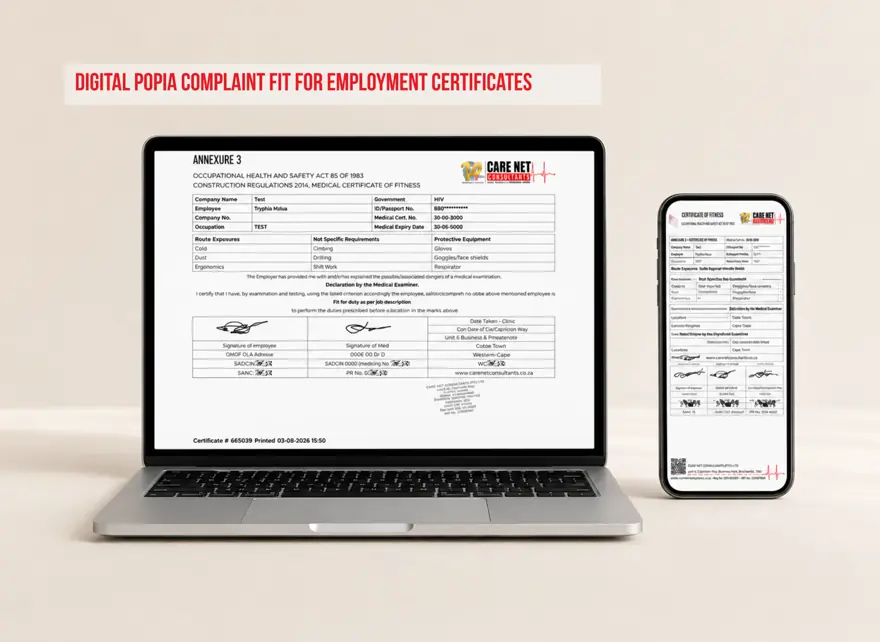
An audit-ready certificate of fitness and a completed Annexure 3 for every worker.
The Annexure 3, explained simply
Before the medical, the employer completes an Annexure 3 form. It lists the worker's job, the risks and exposures on your site, and the protective equipment the job needs. Our practitioner then tests against that form and issues the medical certificate of fitness, including fit with restrictions or fit with conditions where that applies.
Not sure how to complete it, or which category a worker falls into? Ask us. That is what we do every day.
The Construction Regulations, on your site
Construction is one of the most regulated industries in South Africa. The Construction Regulations 2014, made under the OHS Act 85 of 1993, name medical fitness in regulation after regulation. Here is what each one asks of you, and what it looks like on the ground.
Every worker, a valid certificate
A contractor must ensure that every employee has a valid medical certificate of fitness, specific to the construction work to be performed, issued by an occupational health practitioner in the form of Annexure 3.
No valid certificate, no gate access. Keep copies on site and check expiry dates before the worker's first shift, not after.
Read regulation 7 in the gazetteThe risk assessment leads
Before work starts, a competent person must do a risk assessment of the construction work. The risks it identifies are the same risks your Annexure 3 forms must declare.
Your risk assessment and your Annexure 3 forms must tell the same story. An inspector reads both. If they disagree, you have a finding.
Read regulation 9 in the gazetteFall protection needs proof of fitness
Your fall protection plan must include the process for evaluating the medical fitness of every employee who works in a fall risk position, and the records of that process.
Heights medicals are not a nice-to-have inside the plan. They are a listed element of it, with records the inspector can ask to see.
Read regulation 10 in the gazetteSuspended platform crews
Workers on suspended platforms must be physically and psychologically fit to work safely at height, confirmed by a medical certificate of fitness.
Facade, painting and rope-supported crews need heights medicals before they clip in, including the vertigo and balance checks.
Read regulation 17 in the gazetteTower crane operators
A contractor must ensure that a tower crane operator has a medical certificate of fitness before operating the crane.
Crane operators carry the heaviest loads over the most heads. Their vision, hearing and reaction medicals are checked, dated and filed.
Read regulation 22 in the gazetteVehicle and mobile plant operators
Operators of construction vehicles and mobile plant must be medically fit, with the certificate to prove it.
TLB, excavator, dumper and forklift operators all fall under this one. The operator medical covers the extra vision and reaction tests.
Read regulation 23 in the gazetteSame project. Same deadline. Two very different Mondays.
Picture two contractors, each starting a 60-worker project on the same morning. The story is made up. The pattern is not.
Site A waited
Site A planned to sort the medicals out "once things settle down". Workers started. Certificates were a mix of expired, missing and borrowed from the last project.
In week three an inspector arrived, opened the health and safety file, and matched the scaffolding crew against the fall protection plan. No fitness records. The work at height stopped there and then, and the crane stood still above it.
Now Site A is paying idle wages, paying plant standing time, phoning around for emergency medicals at walk-in rates, and explaining the delay to the client whose contract has a penalty clause.
Site B booked a mobile clinic
Site B sent us the Annexure 3 forms two weeks before start. A mobile clinic parked on site the Thursday before. Crews rotated through between tasks. Nobody drove to town. Nobody lost a shift.
One rigger's medical picked up early hearing loss. He was moved to lower-noise work with proper protection, kept his job and his hearing, and the record went into the file. That is the law working exactly as intended.
When the same inspector visited Site B, the file was opened, the certificates matched the risk assessment, and the inspector left. The crane never stopped turning.
The moral: compliance was never the product. The product is a site that keeps moving, workers who stay healthy enough to stay skilled, and a file that protects you when someone official opens it. The certificate is just the receipt.
What does one stopped day cost you?
Put in your own figures. The calculator works out what a single day of stopped work costs your site. Then compare that with the cost of a planned medicals day where the clinic comes to you.
Your stoppage estimate
An estimate from your own figures, before contract penalties, emergency medical call-out rates and the cost of rebuilding the programme. It is not a quote or financial advice.
Price a planned medicals day insteadSecure records. Long-term peace of mind.
Health legislation requires some medical records to be kept for 5 years and exposure-related records for up to 40 years. Paper files struggle to survive that long and to meet POPIA. Care Net stores your medical records securely and digitally, and you can verify any certificate online in seconds.
Occupational health, explained on video
Short videos from our team on the tests, the forms and the law, made for site managers and workers alike. New videos are added to our YouTube channel.
