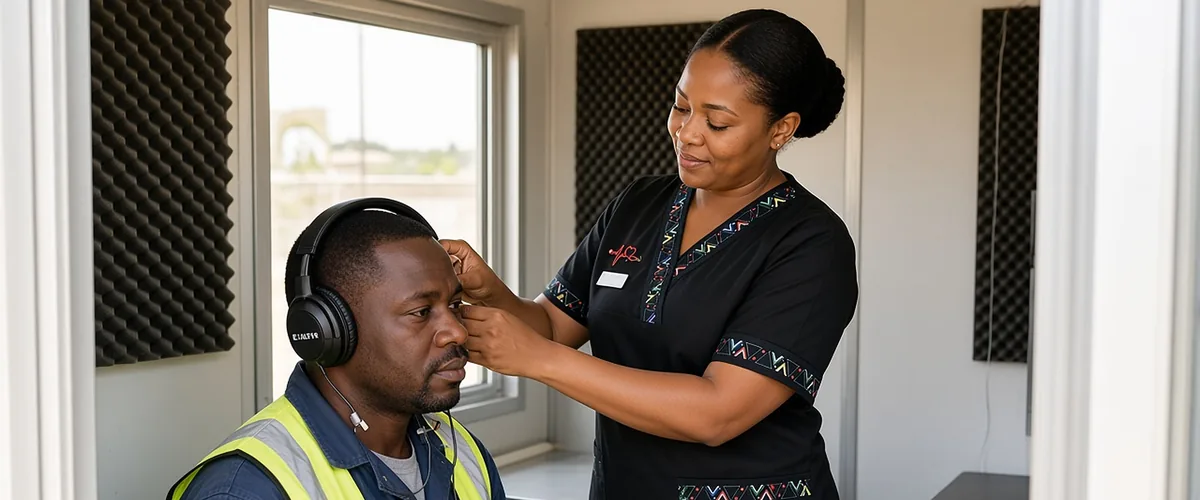
Short answer: The Noise-Induced Hearing Loss Regulations, 2003 were repealed on 06/09/2026. The Noise Exposure Regulations, 2024 now stand alone. They keep the 85 dBA noise rating limit, add a lower noise action level of 82 dBA where ototoxic chemicals or whole-body vibration are present, and set a 24-month cycle for risk assessments.
If your teams have had hearing tests for years, you already hold the habit the new law builds on: baseline audiograms on file, earmuffs on the hooks, a noise survey in the safety folder. That work still counts.
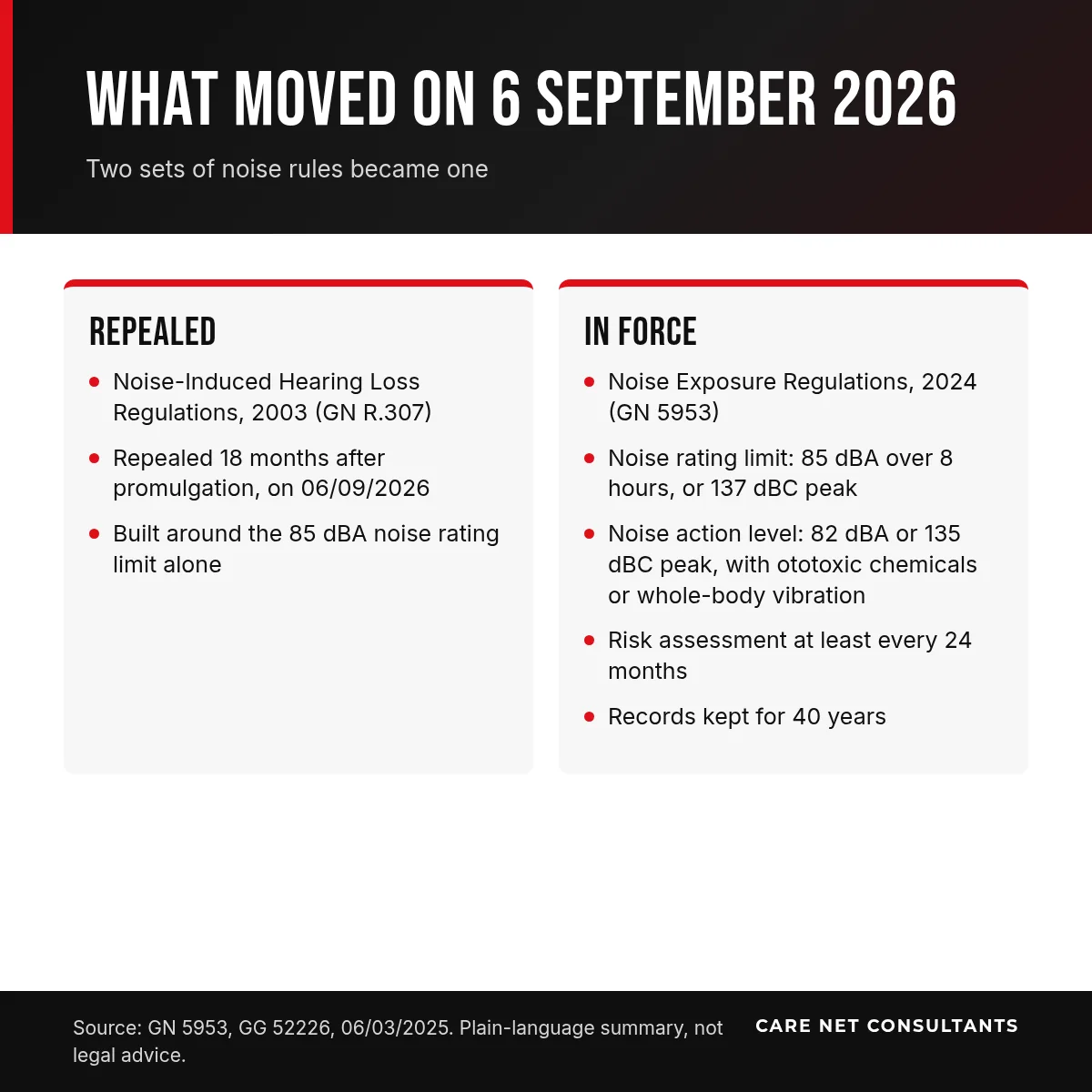
What has changed is the rulebook. On Sunday 06/09/2026 the Noise-Induced Hearing Loss Regulations, 2003 were repealed, and the Noise Exposure Regulations, 2024 now stand alone. A month in, it is worth checking whether your file has caught up.
What happened, and when
The Minister of Employment and Labour published the Noise Exposure Regulations, 2024 as Government Notice 5953 in Government Gazette 52226 on 06/03/2025. Regulation 18 set the repeal of the 2003 regulations (GN R.307) for 18 months after promulgation. ENSafrica and Webber Wentzel both read that date as 06/09/2026.
For 18 months the two sets of rules overlapped, and lawyers questioned how both could apply at once (ENSafrica, 20/04/2026). That question is closed. A 2003 citation in an old procedure now points to a regulation that no longer exists.
The same Gazette carried the Physical Agents Regulations, 2024 (GN 5952), which replaced the Environmental Regulations for Workplaces, 1987 on the same date. They get their own article on 23/10/2026.
The second number
For more than 20 years, 85 dBA was the number that mattered. The 2003 regulations worked on that noise-rating limit alone, with no allowance for hazards that compound noise damage (ENSafrica).
The 2024 regulations keep it. The noise-rating limit is an 8-hour rating level of 85 dBA, or a peak of 137 dBC for impulse noise. Beneath it sits a new noise action level: 82 dBA, or a peak of 135 dBC (regulation 1). The action level applies where people are also exposed to ototoxic chemical agents (chemicals that can damage hearing on their own or together with noise) or to whole-body vibration above the action level in the Physical Agents Regulations.
On a real floor, that means a workshop measured at 83 dBA sat outside the old rules. If the people in it handle certain solvents, or drive plant that sends vibration up through the seat, it may now have to be demarcated as a noise zone, and nobody may enter it without hearing protection worn correctly (regulation 11; Qualitas).
The question is no longer only "how loud is it here?" It is "how loud is it, and what else are these people exposed to at the same time?"
The cycle the law now expects
The 2024 regulations run on dates. In plain terms, the employer must:
- Have a competent person do a noise exposure risk assessment before exposure where reasonably practicable, then at least every 24 months, reviewing it sooner if machines, work methods or controls change, after an incident, or if surveillance shows noise-related harm (regulation 7).
- Where exposure is at or above the limits, have an approved noise inspection authority monitor noise at least every 24 months, measuring as set out in SANS 10083 (regulation 8).
- Train exposed employees before exposure, with refresher training at least once a year (regulation 4).
- Inform the health and safety representative or committee before assessment, monitoring and screening, and share the documented outcomes (regulation 4).
- Run documented medical screening for exposed and vulnerable employees, carried out by an occupational health practitioner, with an occupational medicine practitioner setting requirements and overseeing surveillance (regulation 9).
- Obtain each employee's written informed consent to screening and surveillance (regulation 9).
- Keep records of training, assessments, monitoring, medical screening and surveillance, and maintenance for 40 years (regulation 14).
Removing noise at source still comes first. Hearing protection covers what other controls cannot, and must bring exposure below the relevant level (regulations 10 and 12).
What the Code of Practice for Audiometry changes for your people
The regulations come with a Code of Practice for Audiometry. The points that matter most for planning:
- Baseline or entry test. Employees who will work in a noise zone need a baseline or entry audiogram before, or within 30 days of, starting.
- Periodic tests by exposure. Every 12 months from 85 dBA up to below 105 dBA (from 82 dBA with ototoxic chemicals or whole-body vibration). Every 6 months at 105 dBA or 135 dBC and above. An occupational medicine practitioner may lengthen the interval where an employee's standard threshold shift has not exceeded 25 dB over three years.
- Initial tests for gaps. Noise-zone employees with no valid baseline or entry audiogram needed an initial test within 18 months of publication. That window closed on the repeal date. If someone was missed, test them now and record why.
- Controlled conditions. Test booths are certified to SANS 10182 at least every 12 months, and audiometers calibrated to SANS 10154.
- Clear action points. A standard threshold shift of 25 dB or more means referral to the occupational medicine practitioner and for diagnostic audiology. If confirmed and work-related, it is reported to the Chief Inspector.
- A copy for the worker. On leaving, employees receive their baseline and exit audiograms.
The Code calls itself a move from a reactive to a proactive approach, aimed at detecting early noise-induced hearing loss and preventing further loss.
The true cost of an out-of-date file
The penalty clause is plain. Contravening any of regulations 3 to 15 is an offence carrying a fine or up to 12 months' imprisonment. For a continuing offence, there is an additional fine of R200, or an extra day's imprisonment, for each day it continues (regulation 17). ENSafrica notes that the maximum term under the 2003 regulations was six months (Mondaq, 20/04/2026).
The larger cost sits with the worker. A missed baseline leaves a hearing change with nothing to be measured against. A missed periodic test finds a shift a year later than it could have been. Either way, a person loses something the programme exists to protect, and the employer loses the evidence that it acted in time.
None of this calls for alarm. It calls for a dated check.
Five questions to ask this month
- Do your procedures, risk assessments or training material still cite the NIHL Regulations, 2003?
- When were your last noise risk assessment and noise survey done, and is either close to 24 months old?
- Do any noise-zone workers also use solvents or operate plant with whole-body vibration?
- Does every noise-zone worker have a valid baseline or entry audiogram, and is each periodic test on the right interval?
- Are signed consent forms and audiometry records stored where they will still be readable in 40 years?
If all five answers are clean, your programme has made the move. If one is not, you know where to start.
Where Care Net fits
Care Net Consultants offers hearing screening at our fixed clinics, including Midrand, and through mobile clinic units that come to your site. We can line up baseline, periodic and exit audiometry with your noise survey dates, so the medical side of your programme follows the cycle the regulations expect.
Questions people ask
Are the NIHL Regulations, 2003 still in force?
No. Regulation 18 of the Noise Exposure Regulations, 2024 repealed the 2003 regulations 18 months after promulgation, which is 06/09/2026.
What is the noise action level in the Noise Exposure Regulations, 2024?
It is 82 dBA, or a peak of 135 dBC. It applies where employees are also exposed to ototoxic chemical agents or to whole-body vibration above the action level in the Physical Agents Regulations.
How often must a noise risk assessment be done?
At least every 24 months, and sooner if machines, work methods or controls change, after an incident, or if surveillance shows noise-related harm (regulation 7).
How long must noise and hearing records be kept?
For 40 years. Regulation 14 covers training, assessments, monitoring, medical screening and surveillance records.
How often should audiometry be done under the Code of Practice?
Every 12 months from 85 dBA up to below 105 dBA, and every 6 months at 105 dBA or 135 dBC and above. An occupational medicine practitioner may lengthen the interval in defined cases.
Sources
Accessed on 09/10/2026.
- Department of Employment and Labour: Noise Exposure Regulations, 2024 (GN 5953, Government Gazette 52226, 06/03/2025), with the Code of Practice for Audiometry, gov.za
- Department of Employment and Labour: Noise Exposure Regulations, Code of Practice for Audiometry and Explanatory Notes, labour.gov.za
- Acts Online: Noise Exposure Regulations, 2024, regulation 18 (Repeal of regulations)
- ENSafrica (Willem le Roux, Celeste Coles): Physical Agents Regulations 2024, Noise Exposure Regulations 2024, and Amendment of the General Safety Regulations 2025, 11/03/2025
- ENSafrica (Willem le Roux, Bianca Nolan) via Mondaq: Noise Exposure Regulations, 2024, Exemption from the Provisions of Regulation 8(3), 20/04/2026
- Webber Wentzel (Kate Collier, Kalene Watson): Recent amendments to the Occupational Health and Safety Act, new Regulations, Occupational Health Southern Africa Vol. 31 No. 2 (2025)
- Department of Employment and Labour: Physical Agents Regulations, 2024 (GN 5952, Government Gazette 52226, 06/03/2025), gov.za
- Qualitas Occupational Consulting (Christo de Wet, SAIOH-registered occupational hygienist): How often must a noise survey be done in South Africa?
- National Department of Health: 2026 Health Awareness Calendar
- Department of Employment and Labour: Keynote address by Deputy Minister Jomo Sibiya at the World OHS Day 2026
This article is general information for employers and is not legal or medical advice. Read the regulations for the full requirements and speak to a qualified practitioner about individual health concerns.
← Back to all articles