Know what the law asks of you.
Every industry answers to its own set of regulations. Open your sector below to see the legal duties that sit behind a certificate of fitness, clearly explained, with a link to the source so you can check it yourself.
 Guides

Open your sector, see your duties.
These are the regulations behind every certificate we issue. Each one links to the Act or regulation on the government site, so nothing here has to be taken on trust.
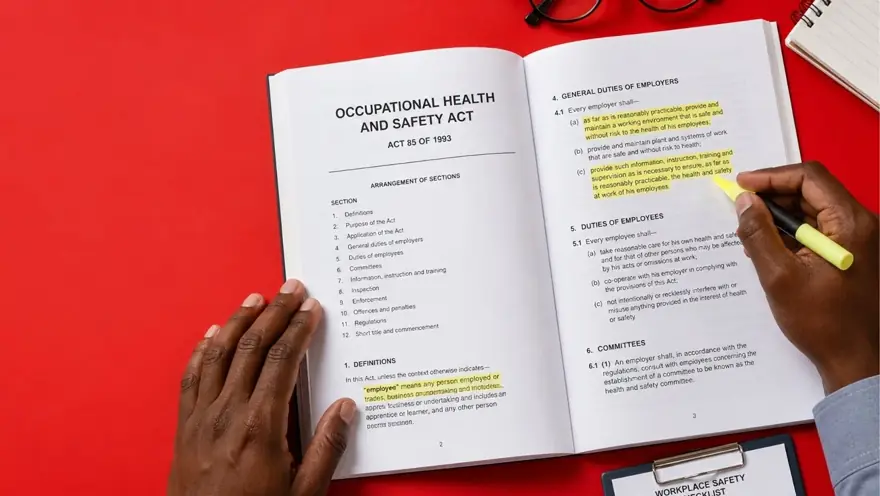
Every employer must provide and maintain, as far as is reasonably practicable, a working environment that is safe and without risk to the health of employees. On a farm or in a packhouse, fit-for-work medicals are part of how that duty is met and recorded.
Where workers are exposed to agrochemicals, including organophosphate and carbamate pesticides, the employer must assess the risk, monitor exposure and arrange medical surveillance. We build the risk-based panel for the exposure and keep the record for the period the law requires.
For organophosphate and carbamate exposure, cholinesterase biological monitoring measures the effect of the chemical on the worker, so poisoning is caught early and action is taken before harm sets in. We track the result against the baseline.
Where workers may be exposed at or above the 85 dBA noise-rating limit around tractors, harvesters and processing plant, the employer must run a hearing conservation programme with baseline and follow-up audiometry. Our hearing tests follow SANS 10083.
Where workers breathe agrochemical vapours or organic dust, respiratory surveillance forms part of the medical. Our spirometry follows the South African Thoracic Society guideline, aligned to ATS and ERS, so a change in lung function is picked up over time.
The Compensation for Occupational Injuries and Diseases Act covers workers who are injured or take ill from their work, including pesticide poisoning, noise-induced hearing loss and occupational asthma. An accurate baseline and ongoing records make a claim straightforward and protect both the worker and the employer.
Every employer must provide and maintain, as far as is reasonably practicable, a working environment that is safe and without risk to the health of employees. For cleaning and recovery teams, fit-for-work medicals are part of how that duty is met and recorded.
Where exposure to a biological agent may occur, which is the daily reality of refuse, sanitation and materials recovery work, the employer must run exposure monitoring and a documented system of medical surveillance overseen by an occupational health practitioner, and make vaccines available where reasonably practicable.
Where workers are exposed to hazardous cleaning chemicals, solvents and sanitisers, the employer must assess the risk, monitor exposure, and arrange medical surveillance. We build the risk-based panel for the exposure and keep the record for the period the law requires.
Where workers may be exposed at or above the 85 dBA noise-rating limit, around balers, shredders and compactors, the employer must run a hearing conservation programme with baseline and follow-up audiometry. Our hearing tests follow SANS 10083.
No person may operate a lift truck or listed lifting machine unless trained and certified, and that rests on being medically fit. We confirm the vision, hearing and reaction the machine needs, so your operator certification stands on a sound medical.
The Compensation for Occupational Injuries and Diseases Act covers workers who are injured or take ill from their work, including from biological or chemical exposure. An accurate baseline and ongoing records make a claim straightforward and protect both the worker and the employer.
Food premises need a Certificate of Acceptability, and the hygiene regulations require food handlers to meet personal hygiene and health standards. Worker health records support that duty and stand up when an environmental health officer asks for proof.
Every employer must provide and maintain, as far as is reasonably practicable, a working environment that is safe and without risk to the health of employees. In a processing plant or kitchen, fit-for-work medicals are part of how that duty is met and recorded.
Where exposure to a biological agent may occur, the employer must run exposure monitoring and a documented system of medical surveillance overseen by an occupational health practitioner. This matters in processing, cold storage and waste handling.
Where cleaning teams are exposed to hazardous chemicals and sanitisers, the employer must assess the risk, monitor exposure, and arrange medical surveillance. We build the risk-based panel for the exposure and keep the record for the period the law requires.
Where workers may be exposed at or above the 85 dBA noise-rating limit on a processing line or around plant, the employer must run a hearing conservation programme with baseline and follow-up audiometry. Our hearing tests follow SANS 10083.
The Compensation for Occupational Injuries and Diseases Act covers workers who are injured or take ill from their work. An accurate baseline and ongoing records make a claim straightforward and protect both the worker and the employer.
Every employer must provide and maintain, as far as is reasonably practicable, a working environment that is safe and without risk to the health of employees. On a factory floor, fit-for-work medicals are part of how that duty is met and recorded.
The general duty extends to the safe use of plant and machinery and to the training and supervision needed to work safely. Confirming a worker is fit for the machine they run is a practical part of meeting it.
Where workers may be exposed at or above the 85 dBA noise-rating limit, the employer must run a hearing conservation programme with baseline and follow-up audiometry. Our hearing tests follow SANS 10083, so your noise zones stay inside the rule.
Where workers may be exposed to a hazardous chemical agent, the employer must assess the risk, monitor exposure, and arrange medical screening and surveillance. We build the risk-based panel for the exposure and keep the record for the period the law requires.
No person may operate a lift truck or listed lifting machine unless trained and certified, and that rests on being medically fit. We confirm the vision, hearing and reaction the machine needs, so your operator certification stands on a sound medical.
The Compensation for Occupational Injuries and Diseases Act covers workers who are injured or take ill from their work, including noise-induced hearing loss. An accurate baseline and ongoing records make a claim straightforward and protect both the worker and the employer.
No person may perform risk work at a controlled mine or works without a current certificate of fitness, and no owner or contractor may permit it. That certificate is the document mineworkers call the Red Ticket. We issue it after a proper examination and record it digitally.
The employer must establish and maintain a system of medical surveillance for employees exposed to health hazards, and the employer pays for the examinations. Our mobile clinics and fixed clinics run that system for you, from baseline to exit.
Every mine must hold a mandatory code of practice on the minimum standards of fitness to perform work, built on job categories and man job specifications. Care Net's OMPs examine your workers against your mine's code of practice, so the certificate matches the job.
When an employee under medical surveillance leaves the mine, an exit examination is performed and the worker receives a copy of the exit certificate. We run exit medicals at the clinic or on site, and the record goes straight into the worker's file.
A record of medical surveillance must be kept confidential and may not be destroyed for 40 years from the last date of surveillance. Paper struggles with that. Care Net keeps every record in secure, POPIA-compliant digital storage.
Professional drivers on public roads need a PrDP medical under the National Road Traffic Act. On the mine, fitness for trackless mobile machines, winders and mine vehicles is confirmed under your code of practice before operator training. Both happen at the clinic or on site.
Every employer must provide and maintain, as far as is reasonably practicable, a working environment that is safe and without risk to the health of employees. For guarding and response teams, fit-for-duty medicals are part of how that duty is met and recorded.
A firearm competency certificate may only be issued to a person who is of stable mental condition and not inclined to violence, and who is not dependent on any intoxicating or narcotic substance. Our occupational medical confirms general fitness and supports these declarations. The competency certificate itself remains a SAPS process.
Where officers may be exposed at or above the 85 dBA noise-rating limit, around shooting ranges or site generators, the employer must run a hearing conservation programme with baseline and follow-up audiometry. Our hearing tests follow SANS 10083.
Where security operations use a lift truck or listed lifting machine, the operator must be trained and certified, and that rests on being medically fit. We confirm the vision, hearing and reaction the machine needs, so the certification stands on a sound medical.
The Compensation for Occupational Injuries and Diseases Act covers workers who are injured or take ill from their work. An accurate baseline and ongoing records make a claim straightforward and protect both the officer and the employer.
The Private Security Industry Regulation Act governs the registration and occupational conduct of security service providers through PSIRA. It sits alongside, but does not replace, the occupational health duties above. Fit-for-duty records support a well-run, compliant operation.
A contractor must ensure that every employee has a valid medical certificate of fitness specific to the construction work, issued by an occupational health practitioner. Mast, tower, rooftop and fibre work is construction work, so the fitness-to-climb medical sits here.
Every employer must provide and maintain, as far as is reasonably practicable, a working environment that is safe and without risk to the health of employees, including the safe use of plant and machinery. Fit-for-work medicals are part of how that duty is met and recorded.
A fall protection plan, prepared by a competent person, is required before work where a person could fall. A worker's medical fitness to work at height underpins that plan, so the medical and the plan work together to keep a climber safe.
Where workers may be exposed at or above the 85 dBA noise-rating limit, around site generators and plant, the employer must run a hearing conservation programme with baseline and follow-up audiometry. Our hearing tests follow SANS 10083.
No person may operate a lift truck or listed lifting machine, including a mobile elevating work platform, unless trained and certified, and that rests on being medically fit. We confirm the vision, hearing and reaction the machine needs.
The Compensation for Occupational Injuries and Diseases Act covers workers who are injured or take ill from their work. An accurate baseline and ongoing records make a claim straightforward and protect both the worker and the employer.
The Occupational Health and Safety Act requires every employer to provide and maintain a working environment that is safe and without risk to the health of employees. Medical surveillance is how a transport or warehousing employer proves that duty is met. We run it for you, at the depot or at the clinic.
A professional driver needs a valid medical certificate of fitness, and the PrDP under the National Road Traffic Act covers vision, hearing, blood pressure, blood sugar and overall fitness for categories G, P and D, including e-hailing drivers. We complete the medical; the OMP completes the online verification and issues the additional documents.
Lift trucks and other lifting machines may only be operated by trained, licensed operators. Before training or re-licensing, the National Code of Practice requires a medical certificate or employer declaration of medical fitness, plus an eye test; a valid PrDP can stand in for the eye test. We confirm the fitness before the training, not after the incident.
Where workers are exposed at or above the noise rating limit, the regulations require audiometric testing: a baseline before exposure and periodic tests after. Loading bays, workshops and reefer plants are noisier than they feel. Our audiometry follows SANS 10083.
The Regulations for Hazardous Chemical Agents require medical surveillance for workers exposed to listed chemical agents, and diesel exhaust in enclosed depots and workshops is a real exposure. The exposure form for the job tells the OMP what to test.
The Compensation for Occupational Injuries and Diseases Act covers employees injured on duty or who contract occupational diseases, and every employer must register and report. A complete, current medical file is the evidence that supports the claim and protects both sides.
Read the full industry guides.
Open any sector for the complete occupational health guide: legal duties, risks, medical surveillance, tests, PPE and per-role guidance.
Tell us the roles and the exposures and we will tell you what the law asks and which medicals answer it.

Crew or contractor? Both routes are covered.
From 10 workers on one site, one of our 16 mobile clinics comes to your gate and clears the crew in one planned window, weekdays and Saturdays. For one contractor or a handful, the fixed clinic medicals page covers the walk-in route.

