The clinic comes to your site. Your team keeps working.
One Care Net mobile clinic at your gate does the whole team's medicals in one planned window. From 10 employees, in any industry, on weekdays and now on Saturdays.
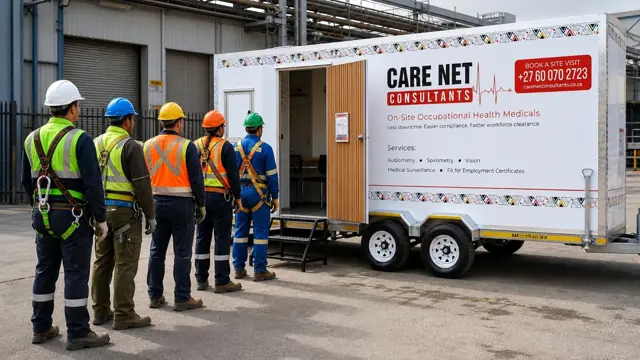

A day in town is a day of lost production.
Medicals are not the problem. Getting a whole team to a clinic and back is. The mobile clinic removes the trip, not the standard.

Sending 40 workers to a clinic in town costs a day of production, plus transport, plus the queue. The unit at your gate gives you that day back.

Some sites are hours from the nearest clinic. Our 16 units work where your people work, from farm roads to mine gates to depots.

At a fixed clinic a big group spreads across days and certificates trickle in. One unit clears the whole team in one planned window.

Load-shedding closes many clinics for hours. Most of our units carry inverters and battery packs, so your booking holds and the schedule does not slip.
Ready to bring the clinic to your gate?
Tell us about your site and your workforce. A sales executive replies the same working day with a fixed-price proposal.

Built for the way your site actually runs.
The same SANS-aligned medicals as our fixed clinics, delivered in a window your production plan can live with.

A planned window at your gate. Workers walk in, get tested, and walk straight back to work. No transport, no town queue.
Operations
You do not need a big site. Ten employees is enough to book a unit, so smaller teams get the same service as the major contracts.
Any site size
Book a Saturday window and your production week stays untouched. The medicals happen, the line never stops.
Operations
Most units carry inverters and battery packs. A power cut at your site or in our schedule does not cancel your medicals.
Every region
Every medical is captured in My Clinic Online, our POPIA-aware record system, so your file is ready when the inspector or auditor asks.
SHEQ
Fixed clinics, mobile clinics and records under one roof, with clear unit pricing agreed up front. No surprises at month end.
ProcurementSaturdays. Power cuts. Covered.
On-site medicals are now available on Saturdays. Keep your weekday production plan whole and let the team certify on the quiet day. Saturday slots are limited, so book early.
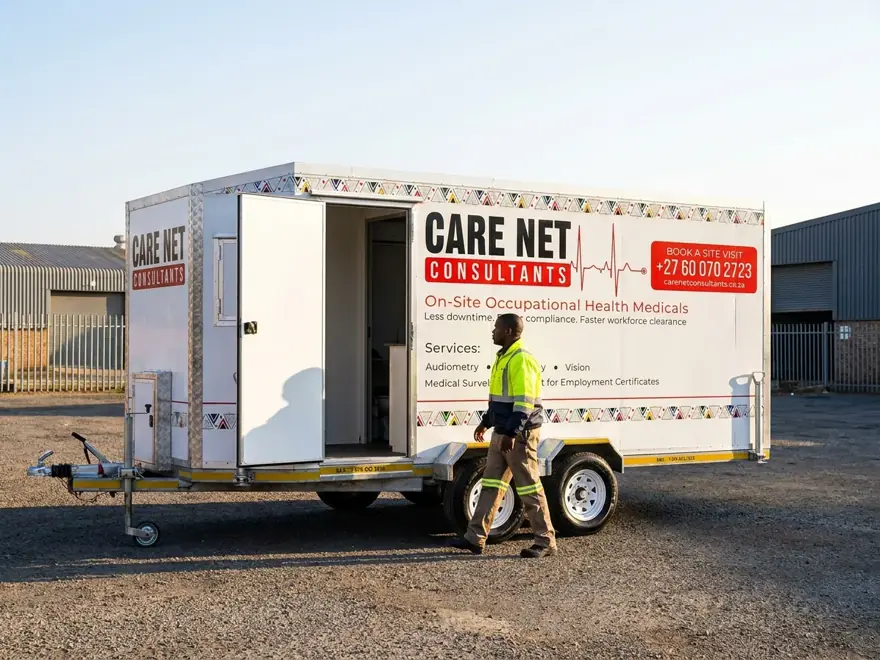
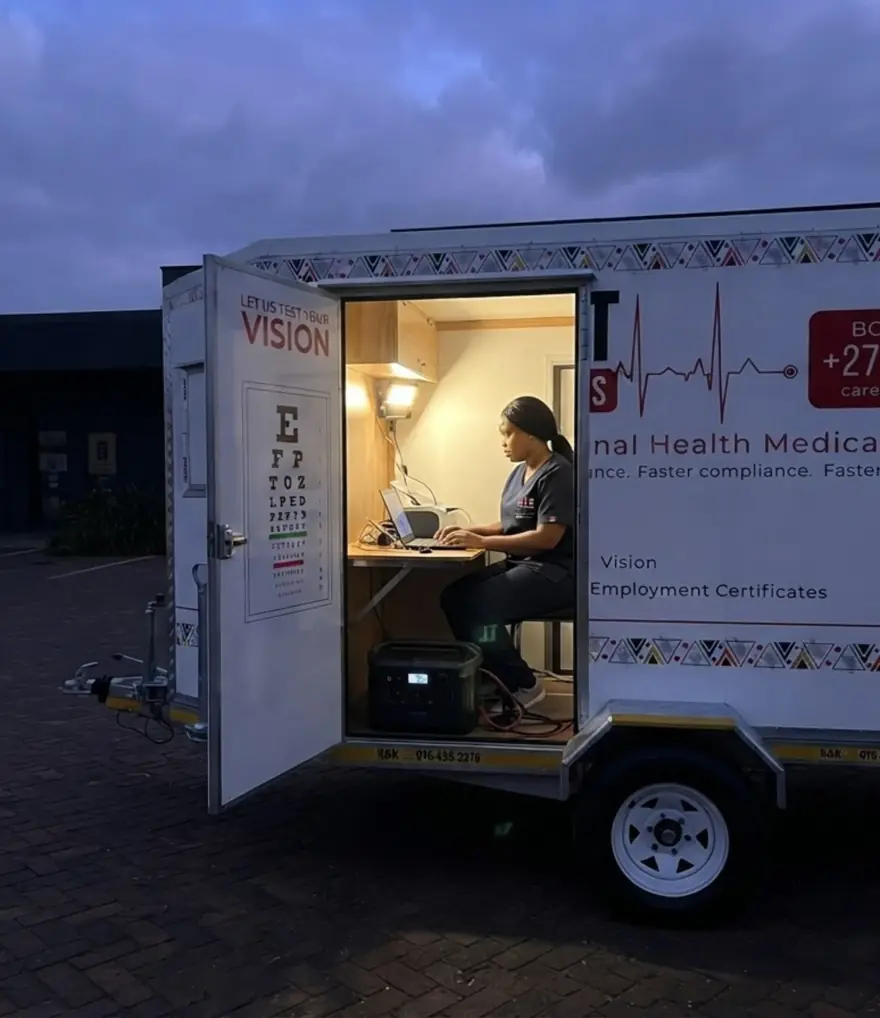
Most of our mobile clinics carry inverters and battery packs. When the lights go out at your site, the unit keeps testing and your schedule holds.
Every worker fits one of four categories.
Each category needs a certificate of fitness and a completed Annexure 3. We build the right test set for each one.

Limited exposure to dust, noise, or hazardous chemicals.
- Health questionnaire and vitals
- Vision, hearing, lung function
- Urine screening

Work on movable scaffolding or suspended platforms at 1.5 metres and higher.
- Everything in General
- Fitness for height assessed and recorded
- Supports your fall protection plan

Anyone who drives or operates plant: tower cranes, mobile plant, and construction vehicles.
- Everything in General
- Vision and reaction suited to plant
- Substance testing where policy requires

Electrical work on site, often at height and around live current.
- Everything in General
- Colour vision screening for wiring
- Fitness for height and live work
Swipe sideways to see all four categories.
| Test | General | Working at heights | Drivers, machine operators & forklift drivers | Electricians |
|---|---|---|---|---|
| Baseline questionnaire (medical and family history) | ||||
| Working at heights questionnaire | – | – | – | |
| Weight | ||||
| Height | ||||
| Blood pressure | ||||
| Urine | ||||
| GlucoseRisk-based medicals only | – | |||
| Audiometry (hearing)SANS 10083 | ||||
| Spirometry (lung function)SATS guideline, ATS and ERS aligned | ||||
| Antibacterial disposable mouthpieceSANS approved, single use | ||||
| Snellen eye test | – | – | ||
| Keystone vision screen | – | – | ||
| Referral check-upAt one of our clinics only | ||||
| Risk-based exposures | ||||
| Annexure 3 risk-based exposure form | ||||
| Review and sign-off | ||||
| Reviewed by OHNP (occupational health nurse practitioner) | ||||
| Reviewed by OMP (occupational medicine practitioner)Reviews all risk-based medicals | – | |||
| Add-ons at additional cost | ||||
| Biological monitoring | Add-on | Add-on | Add-on | Add-on |
| Drug strip testMulti-drug screening | Add-on | Add-on | Add-on | Add-on |
| Multi-drug cup testChain of custody | Add-on | Add-on | Add-on | Add-on |
| Chest X-rayAll medical types | Add-on | Add-on | Add-on | Add-on |

The law sets different retention periods for different records: some are kept for 5 years, and medical surveillance records for hazardous exposure are kept for 40 years from the date of the last entry, as the Occupational Health and Safety Act and its regulations require. Paper records are easy to lose, hard to secure, and seldom survive these periods intact, which puts your POPIA compliance and your audit defence at risk. Your Care Net records sit in a secure, POPIA-compliant digital storage environment for as long as the law prescribes, ready for audits and access requests.
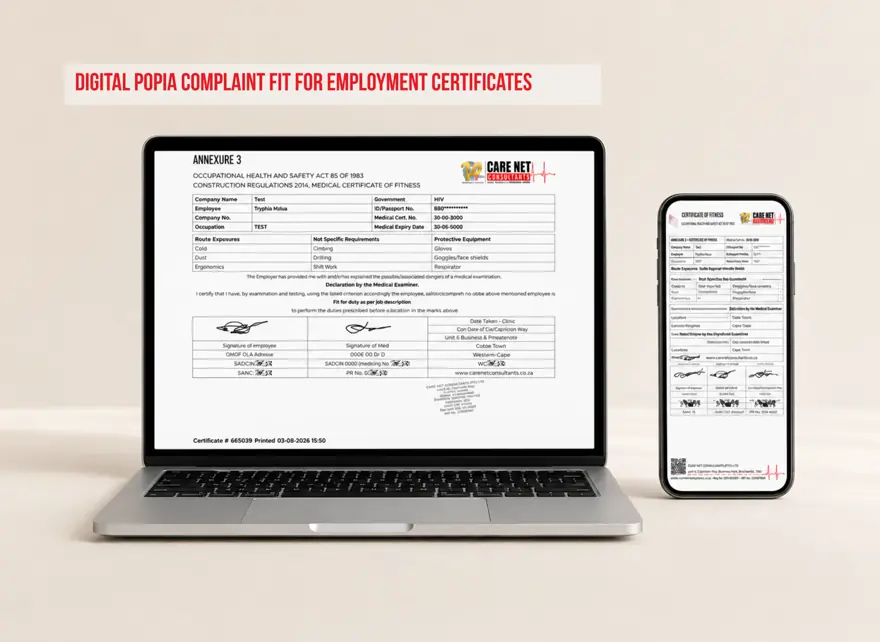
An audit-ready certificate of fitness and a completed Annexure 3 for every worker.
The duty follows the work. So do we.
The law puts medical surveillance on the employer, wherever the work happens, and it does not lower the standard because the clinic is on wheels. A Care Net mobile clinic carries the full duty out at the site itself: the same calibrated equipment, the same accredited testing, the same statutory records as our fixed clinics. Every citation below links to the source so you can read it yourself.
The employer must provide and maintain a working environment that is safe and without risk to the health of employees. That duty applies at every site you run, not only at head office. The mobile clinic brings the surveillance to where the duty lives.
Read the ActIn force since 6 September 2026, replacing the NIHL Regulations 2003. Workers exposed at or above the noise rating limit of 85 dBA need a baseline audiogram before they start work or within 30 days, a periodic audiogram every 12 months (every 6 months at 105 dBA and above), and an exit audiogram. Records are kept for 40 years. The unit keeps that whole schedule running at your gate.
Read the regulationListed hazardous chemical agents require medical surveillance and biological monitoring, with air monitoring records kept for 30 years. We bring the surveillance to the exposure, instead of bussing the exposure to a clinic.
Read the regulationProfessional drivers need a PrDP medical under the National Road Traffic Act. On mines, medical fitness is confirmed before operator training under the code of practice. Both can be done in the unit at your gate, on the same visit as the rest of the team.
Read the ActAcross the noise, chemical and asbestos regulations the wording is the same: the employer shall establish and maintain a system of medical surveillance for employees exposed at or above the limit. A planned annual visit by one mobile clinic is how a multi-site employer keeps that system running everywhere at once.
Read the ActThe law sets different lives for different records: some are kept for 5 years, noise records including every baseline audiogram for 40 years, and air monitoring records for 30 years. Paper files seldom survive that intact. Every on-site medical is captured in our secure POPIA-compliant digital storage, ready for an audit or an access request for as long as the law prescribes.
Read the regulationThe employer completes the Annexure 3 before medicals day, so the practitioner knows the job, the exposures and the protective equipment. Bring the completed form to the unit.
Mobile does not mean less accurate.
A result is only worth the calibration behind it. Because our equipment travels, the standards demand we calibrate it more often than a clinic that never moves. That is the quiet reason a mobile result stands up in an audit.

A fixed audiometer is calibrated once a year. A mobile clinic must be calibrated before it moves to a new site and on return, or every three months, whichever comes first. Daily and weekly biological checks run on top of that. The hearing booth environment is held to SANS 10182.
The standard explained
Before testing begins, the spirometer is verified daily with a 3-litre syringe cycled across low, medium and high flows. The reading must fall within 3 percent of 3 litres or the unit does not test until it does. Every test then uses a SANS approved single-use mouthpiece.
Read the standard
Where a worker is exposed to listed chemical agents, biological monitoring measures the substance, or what the body breaks it into, in blood or urine. Results are read against the Biological Exposure Index in the regulation, so exposure is caught early, before it becomes disease.
Read the regulationThe medical is the small cost. The trip is the big one.
The fee for a medical is similar wherever it happens. What changes the total is the production time a town trip burns. Bring the clinic to the gate and that cost falls away. Here is the arithmetic, with every assumption shown so you can put your own numbers in.
A clinic trip in town typically costs a worker most of a shift once travel, queue and return are counted. On site, the same medical takes a fraction of that.
One unit clears a whole team in one visit, so the lost time does not multiply across days and certificates do not trickle in one by one.
The work stops for the few minutes a worker is in the unit, not for the hours a round trip to a clinic would take.
| Workers needing a medical | 40 |
| Production hours lost per worker for a town trip | 6 hours |
| Fully costed labour rate per hour (example) | R150 |
| Production time cost of sending the team to town | 40 × 6 × R150 = R36 000 |
| Production time cost of an on-site window (about 30 minutes each) | 40 × 0.5 × R150 = R3 000 |
| Production time recovered by booking the unit | R33 000 |
Illustrative arithmetic only. The labour rate, the hours lost and the team size are examples. Put your real figures in and the saving recalculates. This is production time recovered, separate from the medical fee itself.
A depot manager once read the quote and thought the medicals were the cost. Forty names, one figure, signed off. The next month his line stood still for most of a day while those same forty workers queued at a clinic across town. That evening he added up the hours the work had lost, and the real number finally looked back at him.
The medical was never the expensive part. The day was.
The clinic that comes to your gate hands that day back.
See how on-site medicals actually work.
Short, clear explainer videos. The first group applies to every industry; the second speaks to yours.
Straight answers, before you book.
How many workers do we need to book a mobile clinic?
Ten employees is enough. From 10 workers up, a unit comes to your site for a planned window. Larger teams are cleared in one or more shifts on the same visit.
Can we book a Saturday?
Yes. On-site medicals are now available on Saturdays, so you can certify the team without touching the production week. Saturday slots are limited, so book early.
What happens if there is load-shedding on the day?
Most of our mobile clinics carry inverters and battery packs. If the power goes out at your site, the unit keeps testing and your booking holds. Tell us about your site's power situation when you book and we will assign a suitable unit.
Which industries do the units serve?
All nine industries Care Net serves, from construction and mining to factories, farms and depots. The test panel is matched to your industry's risks through the job spec, so every sector gets the medicals its law and its work demand.
How long is a certificate of fitness valid?
One year from the date of issue. The prescribed Annexure 3 form itself states the certificate is valid for one year, and Care Net applies the same one-year validity from the first assessment date when a certificate is transferred.
What must each worker bring on the day?
A Man Job Spec form, or an Annexure 3 for construction (download here), completed by the employer. An ID or passport, since no examination can be done without identification. Glasses or hearing aids if used, and an audiologist report if applicable.
Workers should take chronic medication as usual, and avoid noise, food, sugar, energy drinks and smoking for one hour before the medical.
Whose legal duty is medical surveillance?
The employer's. The OHS Act regulations are explicit: the employer shall establish and maintain a system of medical surveillance for all employees exposed at or above the limit. The mobile clinic is how that system reaches a working site without stopping it.
Why do entry and exit medicals matter so much?
The baseline at entry is the worker's legal reference point for their whole career, and the exit record closes it. For noise, the Noise Exposure Regulations 2024 require a baseline audiogram before work starts or within 30 days, a periodic audiogram every 12 months (every 6 months at 105 dBA and above), and an exit audiogram, with a copy given to the worker when they leave. A deterioration of 10 percent or more against the baseline triggers the compensation process under Instruction 171.
Can a valid certificate move with a worker to a new company?
Yes, through Care Net's certificate transfer service, provided the job description, the risk exposure and the industry stay the same. The clearance remains valid for one year from the first assessment date, no matter how many times it transfers.
Who keeps the records, and for how long?
Medical surveillance records carry long statutory lives. The law sets different periods for different records: some are kept for 5 years, noise records, including every baseline audiogram, for a minimum of 40 years, and air monitoring records under the chemical agent regulations for 30 years. Paper files seldom survive those periods intact.
Every on-site medical is captured in My Clinic Online, a secure POPIA-compliant digital storage environment, so your employer file stays audit ready for as long as the law prescribes.
Is that medical real? Verify it online.
Every Care Net medical is captured digitally in My Clinic Online, our POPIA-aware record system. Check the legality of any Care Net certificate online in seconds, before a worker sets foot on your site.

