Fit for duty, before deployment.
A mobile clinic comes to the depot or muster point for whole shifts and new deployments. A single officer walks into one of four fixed clinics for onboarding or an exit. Fitness for duty, hearing and vision, and firearm-fitness support for armed officers, all in records that verify online in seconds.
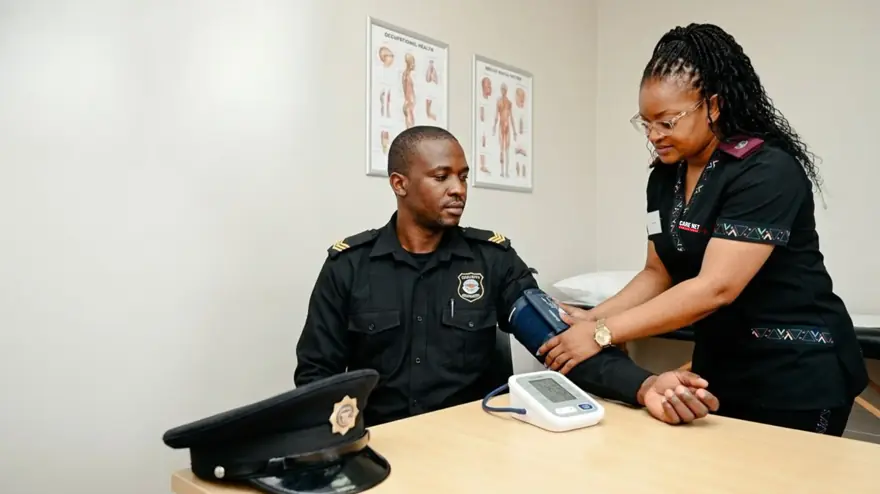

No one deploys on a lapsed certificate.
Whole shifts and new deployments get a mobile clinic at the depot or muster point. Individual onboarding and exits happen at one of four fixed clinics. The four problems below are the ones security operators bring us most.

An officer's medical certificate of fitness expires and they cannot be deployed, with the roster right behind it. We track every renewal on one planner and re-test before the date, on site or at a clinic.

A blank or generic risk form means the exam cannot match the real duty. We help you complete the risk-based exposure form properly, so the practitioner tests the officer against the actual post and its demands.

Guarding teams are scattered across posts and shifts. We bring the mobile clinic to a central depot or muster point and clear the shift together, weekdays and Saturdays included.

A client or a tender asks for fitness-for-duty records for the officers on their site. Every Care Net medical lives in My Clinic Online, so the proof is a search away, not a storeroom away.
Need a shift cleared this month?
Tell us the headcount and the site. A sales executive replies the same working day with a fixed-price proposal.

Your Medical Surveillance Plan is only as strong as the law behind it.
Most plans are written once, copied often, and quietly go stale while the regulations move on. The Care Net Method is our answer: a maintained, versioned body of South African occupational health law that every Plan is built against, reviewed monthly, and ratified by a registered Occupational Medical Practitioner.
Many Care Net clients qualify for the assessment at no charge. It takes a minute to find out.
Do you qualify for a free assessment?
Two questions. No personal or health information is asked.
Eligibility is confirmed by a sales executive before any waiver is applied.
Built for the way a roster actually runs.
The same SANS-aligned medicals, at the depot for the shift or at the clinic for one officer.

Mobile clinics work at the depot or muster point for whole shifts and new deployments. Fixed clinics handle individual onboarding and exits. One partner covers both, one invoice at month end.
Operations
A single new hire or an officer due for a periodic medical can walk into any of our four clinics and leave with the medical done.
Any team size
From 10 workers on one site, a mobile clinic clears a whole shift for a new deployment in one planned window, weekdays and Saturdays included.
Operations
Our clinics run on inverters and generators. Unless a natural disaster or an unforeseen event closes us, the clinic is open.
Every region
Every medical is captured in My Clinic Online, our POPIA-aware record system, ready for a client audit, a tender, or an inspector.
Operations and HR
Fixed clinics, mobile clinics and records under one roof, with clear unit pricing agreed up front. No surprises at month end.
ProcurementFitness for duty. Firearm fitness. Sorted.
Security officers are assessed for fitness for duty, hearing and vision against the demands of the post. For armed officers, the occupational medical confirms general fitness and supports the Firearms Control Act declarations of stable mental condition and no substance dependence; the firearm competency certificate itself remains a SAPS process. Professional drivers on public roads can add the PrDP medical, an add-on at additional cost, because the OMP completes an online verification and issues the additional documents.
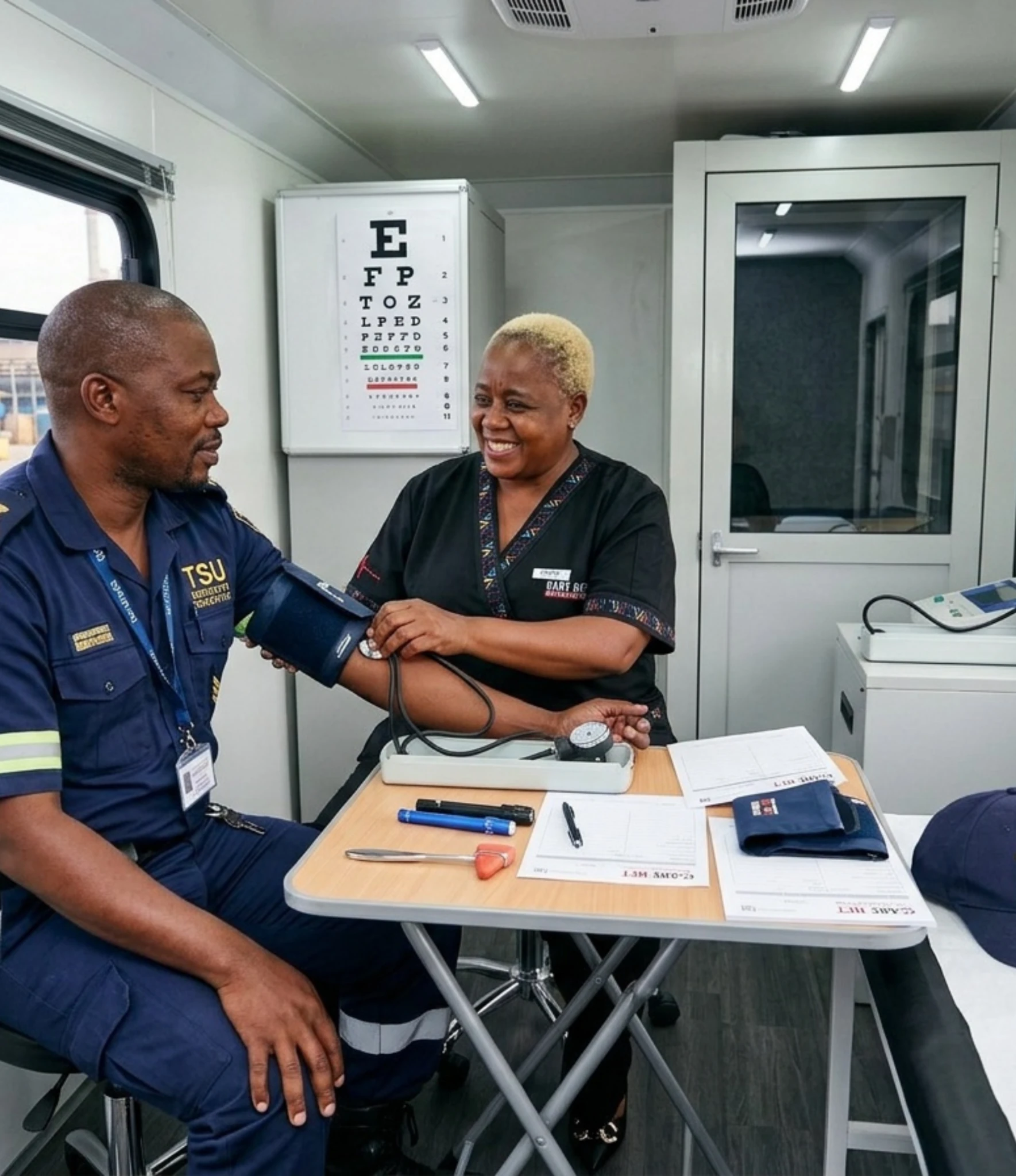
Every medical is captured in My Clinic Online, our POPIA-aware record system. Any Care Net certificate can be checked online in seconds, so no one goes on post on a paper trail.


Every worker fits one of four categories.
Each category needs a certificate of fitness and a completed risk-based exposure form. We build the right test set for each one.

Limited exposure to dust, noise, or hazardous chemicals.
- Health questionnaire and vitals
- Vision, hearing, lung function
- Urine screening

Work on movable scaffolding or suspended platforms at 1.5 metres and higher.
- Everything in General
- Fitness for height assessed and recorded
- Supports your fall protection plan

Anyone who drives or operates plant: tower cranes, mobile plant, and construction vehicles.
- Everything in General
- Vision and reaction suited to plant
- Substance testing where policy requires

Electrical work on site, often at height and around live current.
- Everything in General
- Colour vision screening for wiring
- Fitness for height and live work
Swipe sideways to see all four categories.
| Test | General | Working at heights | Drivers, machine operators & forklift drivers | Electricians |
|---|---|---|---|---|
| Baseline questionnaire (medical and family history) | ||||
| Working at heights questionnaire | – | – | – | |
| Weight | ||||
| Height | ||||
| Blood pressure | ||||
| Urine | ||||
| GlucoseRisk-based medicals only | – | |||
| Audiometry (hearing)SANS 10083 | ||||
| Spirometry (lung function)SATS guideline, ATS and ERS aligned | ||||
| Antibacterial disposable mouthpieceSANS approved, single use | ||||
| Snellen eye test | – | – | ||
| Keystone vision screen | – | – | ||
| Referral check-upAt one of our clinics only | ||||
| Risk-based exposures | ||||
| Risk-based exposure form | ||||
| Review and sign-off | ||||
| Reviewed by OHNP (occupational health nurse practitioner) | ||||
| Reviewed by OMP (occupational medicine practitioner)Reviews all risk-based medicals | – | |||
| Add-ons at additional cost | ||||
| Biological monitoring | Add-on | Add-on | Add-on | Add-on |
| Drug strip testMulti-drug screening | Add-on | Add-on | Add-on | Add-on |
| Multi-drug cup testChain of custody | Add-on | Add-on | Add-on | Add-on |
| Chest X-rayAll medical types | Add-on | Add-on | Add-on | Add-on |

The law sets different retention periods for different records: some are kept for 5 years, and medical surveillance records for hazardous exposure are kept for 40 years from the date of the last entry, as the Occupational Health and Safety Act and its regulations require. Paper records are easy to lose, hard to secure, and seldom survive these periods intact, which puts your POPIA compliance and your audit defence at risk. Your Care Net records sit in a secure, POPIA-compliant digital storage environment for as long as the law prescribes, ready for audits and access requests.
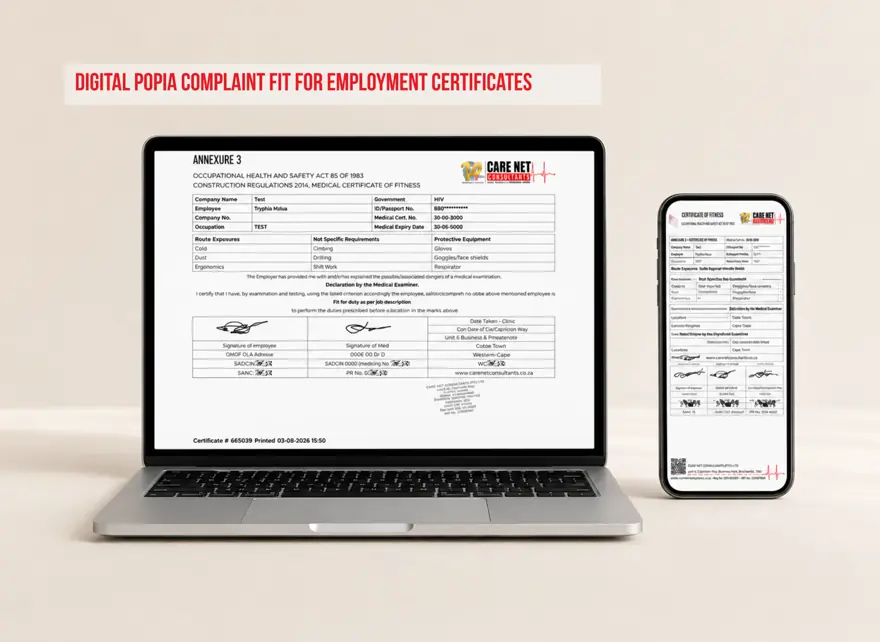
An audit-ready certificate of fitness and a completed risk-based exposure form for every worker.
Four clinics. Real reviews on Google.
One officer or a handful? Walk in, or call to book and skip the queue. Ratings shown are from our Google Business Profiles.
Honest reviews build trust with the next visitor and help us invest in better clinic experiences. If something went wrong, please tell our team before you leave; we solve problems on the spot.
The duty is yours. We make it provable.
Safety and security medicals answer to the OHSA and, for armed officers, the Firearms Control Act. These are the rules behind every certificate we issue, clearly explained, with the source one click away.
Every employer must provide and maintain, as far as is reasonably practicable, a working environment that is safe and without risk to the health of employees. For guarding and response teams, fit-for-duty medicals are part of how that duty is met and recorded.
Read the ActA firearm competency certificate may only be issued to a person who is of stable mental condition and not inclined to violence, and who is not dependent on any intoxicating or narcotic substance. Our occupational medical confirms general fitness and supports these declarations. The competency certificate itself remains a SAPS process.
Read the ActWhere officers may be exposed at or above the 85 dBA noise-rating limit, around shooting ranges or site generators, the employer must run a hearing conservation programme with baseline and follow-up audiometry. Our hearing tests follow SANS 10083.
Read the regulationsWhere security operations use a lift truck or listed lifting machine, the operator must be trained and certified, and that rests on being medically fit. We confirm the vision, hearing and reaction the machine needs, so the certification stands on a sound medical.
Read the regulationThe Compensation for Occupational Injuries and Diseases Act covers workers who are injured or take ill from their work. An accurate baseline and ongoing records make a claim straightforward and protect both the officer and the employer.
Read the ActThe Private Security Industry Regulation Act governs the registration and occupational conduct of security service providers through PSIRA. It sits alongside, but does not replace, the occupational health duties above. Fit-for-duty records support a well-run, compliant operation.
Read the ActThe employer completes the exposure form before medicals day, so the practitioner knows the post, the exposures and the demands of the duty. Send it with the officer or attach it to your booking.
Is that medical real? Verify it online.
Every Care Net medical is captured digitally in My Clinic Online, our POPIA-aware record system. Check the legality of any Care Net certificate online in seconds, before a worker sets foot on your site.

Know exactly what to expect, on site or in clinic.
Short, clear explainer videos. The first group plans the medicals; the second explains the medical itself.
Straight answers, before medicals day.
Do security officers need a medical?
The employer's general duty under the Occupational Health and Safety Act is to confirm that workers are fit for the work and its risks, and a fit-for-duty medical is how guarding and response companies meet and record that for officers. The exact panel depends on the post and is confirmed at booking.
How does the medical support firearm fitness for armed officers?
The Firearms Control Act requires that a firearm competency certificate only goes to a person who is of stable mental condition, not inclined to violence, and not dependent on an intoxicating or narcotic substance. Our occupational medical confirms general fitness and supports those declarations. The competency certificate itself is issued through SAPS, not by Care Net.
Can you clear a whole shift for a new deployment?
Yes. From 10 workers on one site, a mobile clinic comes to the depot or muster point and clears the whole shift in one planned window, weekdays and Saturdays included. Tell us the headcount and the dates in the quote form, and a sales executive builds the plan with you.
How often must the medical be repeated?
It depends on the post and the risks, and the Occupational Medical Practitioner confirms the schedule for each officer. We track every renewal date on one planner, so a certificate is re-tested before it lapses, not after.
What must the officer bring on the day?
A completed risk-based exposure form from the employer. An ID or passport, since no examination can be done without identification. Glasses or hearing aids if used, and an audiologist report if applicable. Take chronic medication as usual, and avoid noise, food, sugar, energy drinks and smoking for one hour before the medical.
Can one officer come to a clinic?
Yes. One officer is enough. Walk in or book at Midrand (875 16th Road, Unit 2 Alphen Square North, Randjespark, 1685), Elandsfontein (Cnr North Reef and Atlas Road, Shop 2 Delmond Centre, 1429), Brackenfell in Cape Town (Cnr Kruis and Capricorn Way, Unit 15 Reserve 1, 7560) or Gqeberha (40 6th Avenue, 6045). Directions and reviews are in the clinic section above.
Do response drivers need a medical?
Officers who drive a response vehicle are tested for the vision, hearing and reaction the role needs. Professional drivers on public roads can add the PrDP medical, an add-on at additional cost, because the OMP completes an online verification and issues the additional documents.
Will a client audit be able to check the records?
Yes. Every Care Net medical is captured in My Clinic Online, our POPIA-aware record system, and any certificate verifies online in seconds. When a client, a tender or an inspector asks for fitness-for-duty records, it is a search away, not a storeroom away.
How long do you keep the medical records?
The law sets different retention periods: some records are kept for 5 years, and surveillance records for hazardous exposure for 40 years, as the Occupational Health and Safety Act and its regulations require. Care Net keeps every record in secure, POPIA-compliant digital storage.
Whole shift or one officer? Both routes are covered.
From 10 workers on one site, one of our 16 mobile clinics comes to your depot or muster point and clears the shift in one planned window, weekdays and Saturdays. For one officer or a handful, the fixed clinic medicals page covers the walk-in route.

