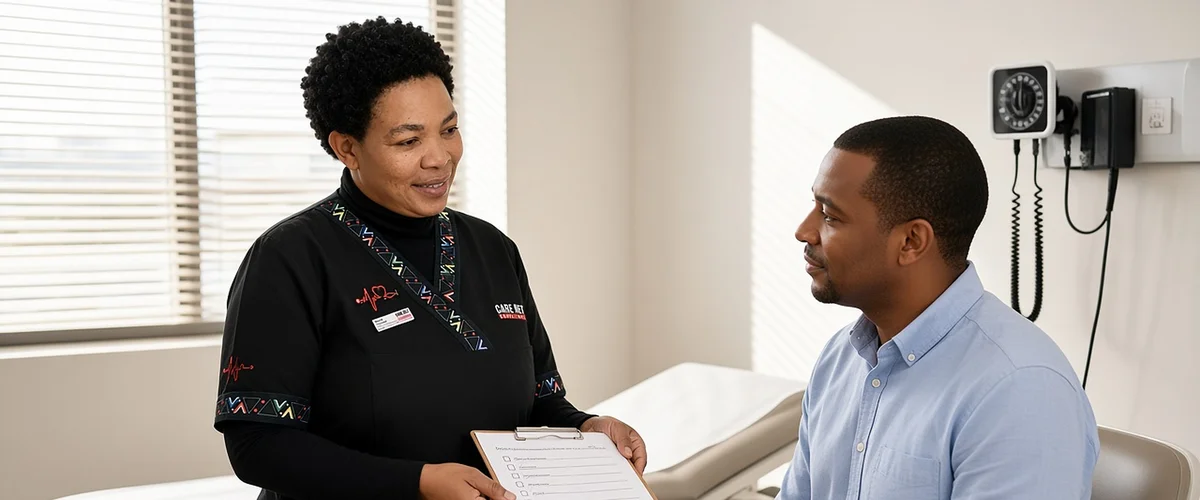
Short answer: Psychosocial risk in the workplace is harm that comes from how work is designed, organised and managed: workload, working hours, role clarity, control over the job, support and fairness. The International Labour Organization (ILO) calls these workplace hazards, not personal weaknesses.[1] A medical cannot diagnose them, but it gives a qualified practitioner a private conversation with each worker, and that is often where the first sign shows.
Picture a Tuesday at 06:40. The machines are warm, the tea is poured, and a supervisor who has not had a full night's sleep in a fortnight is deciding whether to mention it. Nothing on the floor will register it. No meter will beep.
That is the part of workplace health we measure least. October is Mental Health Awareness Month on the Department of Health's 2026 calendar, and World Mental Health Day fell on 10/10/2026.[2] It is a fair moment to look at the risk that sits beside noise, dust and chemicals but never shows on a reading.
What the ILO and our own department said this year
The theme of this year's World Day for Safety and Health at Work was "Let's ensure a healthy psychosocial working environment".[1] The ILO defines that environment as how jobs are designed, organised and managed, and the policies and practices that govern work. When those factors harm workers, they become hazards, in the same group as physical, chemical and biological ones.[1]
South Africa marked the day with a keynote address. In it, Deputy Minister Jomo Sibiya of the Department of Employment and Labour listed what he called workplace hazards: stress, burnout, workplace violence, harassment, bullying, excessive workloads, poor leadership and job insecurity. He added a sentence employers should read twice: these are not personal weaknesses.[3]
He also quoted the new ILO global report. Its estimates are that psychosocial risk factors are responsible for more than 840,000 deaths each year worldwide, linked to cardiovascular disease and mental disorders, and for the loss of about 1.37 per cent of global GDP. The same report found that 35 per cent of workers globally work more than 48 hours a week, and that 23 per cent have experienced violence or harassment in their working life.[3][4]
Those are global figures. We have no South African prevalence number to offer you, and we will not guess one.
What counts as a psychosocial risk
The World Health Organization (WHO) published guidelines on mental health at work in 2022. They group the risks into ten categories, including:[5]
- Workload and work pace: overload or under-load, constant deadlines, machine pacing.
- Work schedule: shift work, night shifts, unpredictable or long hours.
- Control: little say over how and when the work is done.
- Role in the organisation: unclear or conflicting roles, responsibility for other people.
- Interpersonal relationships: isolation, conflict, bullying, harassment, little support.
- Career development: uncertainty, poor pay, job insecurity.
- Home and work: competing demands, or living away from family on an assignment.
The WHO list also names poor environmental conditions, and it gives excessive noise as an example.[5] The noise rules we covered on 13/10/2026 and this topic are closer neighbours than they first seem.
The legal footing, in plain terms
Section 8 of the Occupational Health and Safety Act, 1993 requires every employer to provide and maintain, as far as is reasonably practicable, a working environment that is safe and without risk to the health of employees. It also asks employers to establish what hazards are attached to the work.[6] The Deputy Minister's keynote ties this duty to psychosocial hazards.[3]
The Ergonomics Regulations, 2019 cover cognitive and organisational factors as well as posture and repetition. The department reported inspection findings on them: only 32 per cent of employers inspected in 2023, 35 per cent in 2025 and 31 per cent in 2026 had done the ergonomics risk assessment required by regulation 6. It said cognitive factors, including psychosocial risks, were under-assessed.[3]
Read that as an invitation, not an accusation. If your risk assessment looks only at what people lift, climb and breathe, you are in the majority. The gap is also the opportunity.
What the WHO recommends employers do
The WHO's first recommendation is to act on the work itself, not only on the individual. It recommends organisational interventions that address psychosocial risk factors, including participatory approaches, and says an assessment of those factors should sit inside your regular occupational health risk assessment.[5] It also recommends training managers to prevent stressful work environments and to respond to workers in distress.[7]
A practical first step, taking nothing more than an hour:
- Pick one team and one risk from the list above, for example schedules.
- Ask the team, in a safe setting, what makes the work harder than it needs to be.
- Change one thing you control, such as roster notice, break timing or who decides job allocation.
- Return to the team in a month and ask whether it helped.
That is participation, which is the approach the WHO describes.[5] It costs little, and it tells people you listen.
What a medical can notice, and what it cannot
An occupational health medical is not a mental health assessment, and Care Net Consultants does not diagnose. Every Care Net medical includes a risk-based exposure form and a review by an occupational health nursing practitioner (OHNP).[8] That is a private conversation with a qualified professional, which some workers have never had at work.
A practitioner may notice that a worker is exhausted, or that something they say points to strain. The right response is not a verdict. It is to listen, to say what the options are, and to refer the worker to qualified care. For immediate support, the South African Depression and Anxiety Group (SADAG) runs a free 24-hour Suicide Crisis Helpline on 0800 567 567 and a Mental Health Helpline on 0800 456 789.[9]
An employer receives the fitness outcome, such as fit for duty or fit with reasonable adjustments, not the worker's private conversation.
The cost of not looking
The ethical case comes first. A worker who is carrying more than anyone has noticed is paying for it at home, in their sleep and in their health. The business case follows: the ILO links these risks to cardiovascular disease and mental disorders, and the department links them to absenteeism, conflict and lost productivity.[3][4] None of this appears on a meter, so it tends to appear first as resignations, errors and sick leave.
A fair question to take to your next meeting
Which of the ten WHO categories is quietest in your risk assessment today? Start there.
If you would like to plan a wellness day or talk to a consultant about how medicals and health awareness fit together, we are happy to have that conversation.
Questions people ask
What is a psychosocial risk at work?
A psychosocial risk is a feature of how work is designed, organised or managed that can harm health. Examples are heavy workload, unpredictable hours, low control, unclear roles, bullying and job insecurity.
Is psychosocial risk covered by South African law?
Section 8 of the Occupational Health and Safety Act, 1993 requires employers to provide, as far as is reasonably practicable, a working environment that is safe and without risk to health. The Department of Employment and Labour has linked that duty to psychosocial hazards, and the Ergonomics Regulations, 2019 include cognitive and organisational factors.
Can an occupational health medical diagnose a mental health condition?
No. A medical is a fitness for work assessment. A qualified practitioner may notice signs of strain and refer the worker to appropriate care, but a diagnosis belongs to a suitably qualified clinician.
Where can a worker get urgent help in South Africa?
SADAG runs a free 24-hour Suicide Crisis Helpline on 0800 567 567 and a Mental Health Helpline on 0800 456 789.
Sources
Accessed on 09/10/2026.
- ILO: World Day for Safety and Health at Work 2026, Let's ensure a healthy psychosocial working environment
- National Department of Health: 2026 Health Awareness Calendar (October)
- Department of Employment and Labour: Keynote address by Deputy Minister Jomo Sibiya at World OHS Day 2026
- ILO: The psychosocial working environment, global developments and pathways for action (2026 report page)
- WHO: Guidelines on mental health at work (2022), including Box 1 on psychosocial risks
- Occupational Health and Safety Act 85 of 1993, section 8 (Acts Online)
- WHO and ILO: New measures to tackle mental health issues at work (28/09/2022)
- Care Net Consultants: Fixed clinics and what every medical includes
- South African Depression and Anxiety Group (SADAG): helpline numbers
This article is general information for employers and is not legal or medical advice. Read the regulations for the full requirements and speak to a qualified practitioner about individual health concerns.
← Back to all articles