
Short answer: Regulation 10 of the Construction Regulations, 2014 requires a fall protection plan, and that plan must include the processes for evaluating employees' medical fitness to work at a fall risk position, with records.[1] A certificate of fitness in the form of Annexure 3 is one document in that process. Medical fitness for work at height is the evaluation behind it, and the plan must say how it is done and kept.
Ask a site manager whether a worker is certified to climb and you will usually get a quick yes, along with a file. Ask whether that worker is fit to climb today, and the answer takes longer.
Both questions matter. The regulation is written around the second one.
What regulation 10 asks for
A contractor must designate a competent person to prepare a fall protection plan, make sure it is implemented, amended where necessary and maintained, and take steps to make sure it is followed.[1] The plan must include, among other things:[1]
- A risk assessment of all work carried out from a fall risk position, with the procedures used to address the risks identified per location.
- The processes for the evaluation of employees' medical fitness necessary to work at a fall risk position, and the records of those evaluations.
- A programme for training employees who work from a fall risk position, with records.
- The procedure for inspecting, testing and maintaining fall protection equipment.
- A rescue plan with the necessary procedure, personnel and suitable equipment.
Regulation 10(4)(b) adds that no person may be required to work in a fall risk position unless the work is performed safely as contemplated in the plan.[1] The medical fitness process is part of how the plan makes that true. The regulations define a fall protection plan as a documented plan covering all risks of working from a fall risk position, the procedures to eliminate the risk of falling, and a rescue plan.[1]
Certified is a document, fit is a process
Regulation 7(8) requires every construction employee to hold a valid medical certificate of fitness, specific to the construction work and issued in the form of Annexure 3.[1] That is the certificate.
Regulation 10(2)(b) asks for something wider: a process for evaluating medical fitness for a fall risk position, and the records. A certificate on file proves the process produced an output once. The plan must show how the process works, who is evaluated, and where the records are kept.
For suspended platforms, regulation 17(12) is explicit. Workers must be medically fit to work safely in a fall risk position or similar environment by being in possession of a medical certificate of fitness.[1]
Where this sits in the Act
The regulations are made under the Occupational Health and Safety Act, 1993. Section 8 of the Act sets the employer's general duty to provide and maintain, as far as reasonably practicable, a working environment that is safe and without risk to health.[4] A fall protection plan with a working medical fitness process is one way an employer shows it has taken that duty seriously on site. Regulation 10(1) also requires the contractor to take steps to ensure continued adherence to the plan.[3] A plan that sits in a drawer does not meet that.
What a fitness evaluation can look at
The regulations do not list the tests, and neither do we pretend they do. The decision on what a worker needs sits with the occupational health practitioner, using the criteria the employer supplied on Annexure 3.[1] That is why the employer's columns on the form matter: if your Annexure 3 says fall risk under possible exposures and names the work from height under job specific requirements, the practitioner knows what to test against.
At Care Net, our working at heights category assesses and records fitness for height, and supports your fall protection plan. It adds a working at heights questionnaire to the general panel, and every risk-based medical, which includes working at heights, is reviewed by an occupational medicine practitioner (OMP).[2] The standard panel includes vision, hearing, lung function, blood pressure and urine screening, and the final panel is confirmed against the job risk at booking.[2] That is how we run the medical. It is not a list taken from the regulation.
Four steps, in order
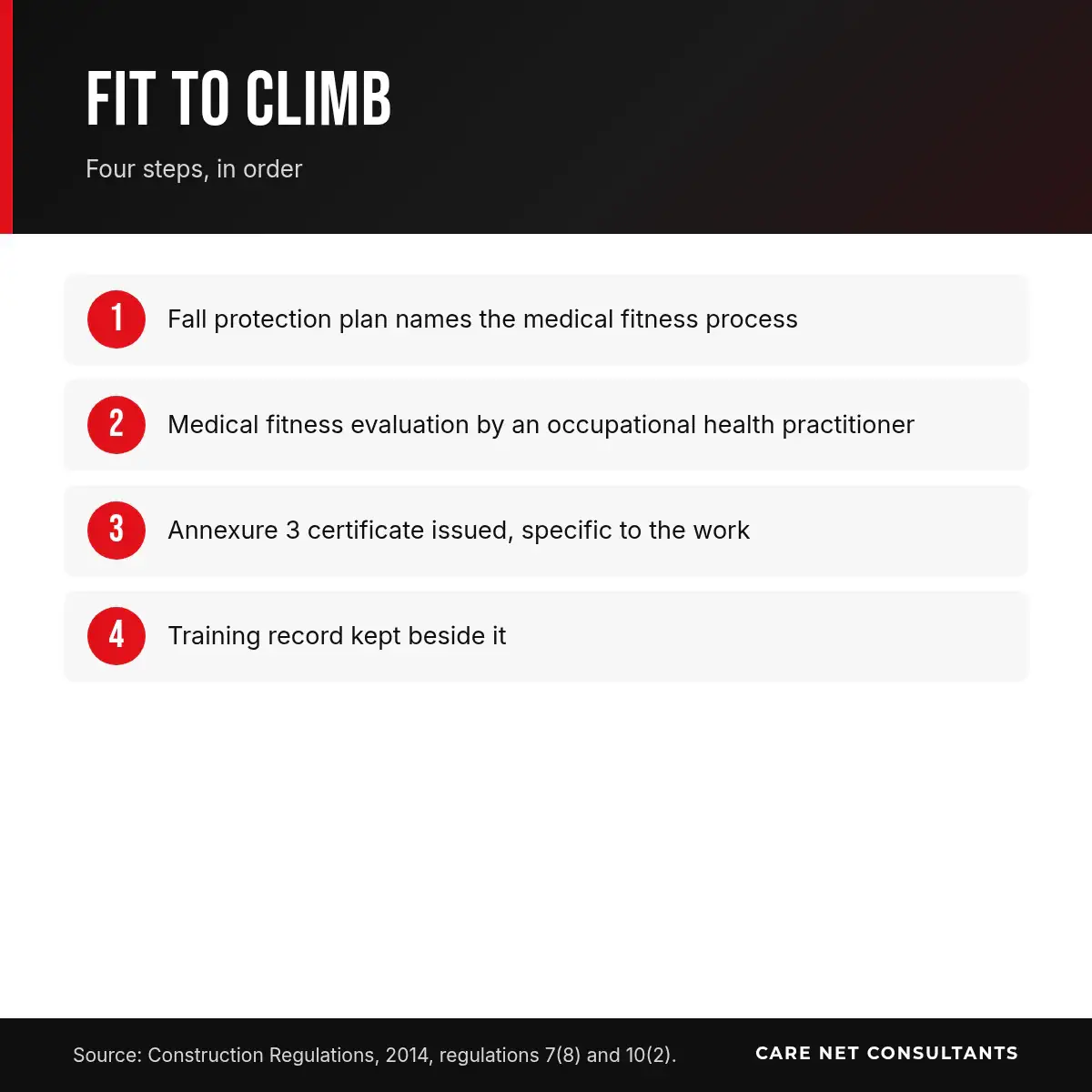
- The fall protection plan names the process. Your competent person writes it in, with the records.
- The medical fitness evaluation takes place. It is done by an occupational health practitioner against the criteria you set.
- The Annexure 3 certificate is issued. It must be valid and specific to the work.[1]
- The training record sits beside it. The plan must include a training programme for employees working from a fall risk position, with records.[1]
If one of those four is missing, the file tells an incomplete story. You can have a certificate without a plan that mentions it. You can have a plan that says medical fitness is evaluated with nothing on file.
The questions that tend to come up
Does the regulation set a height? The definitions say "fall risk" means any potential exposure to falling either from, off or into.[1] That definition gives no height threshold. Do not rely on a number you have heard. Ask your competent person to apply the definition to each task on your site.
Does a general medical cover work at height? Not by itself. The certificate must be specific to the construction work to be performed.[1]
Does a certificate stay valid for ever? The regulation says "valid" and does not give a period in the text of regulation 7(8). Your practitioner states any conditions and the validity on the certificate, and your fall protection plan should state your review interval.
What to do this month
- Open your fall protection plan and find the medical fitness section. If there is not one, that is the first job.
- List everyone who works from a fall risk position and check each has a current Annexure 3 specific to that work.
- Check that evaluation records, training records and certificates are in the same place.
- Plan the next batch. Our clinics are open until 17/12/2026, and the weeks before the shutdown are when most employers try to book.
None of this is dramatic. It is a plan, a process, a certificate and a record, in that order.
Questions people ask
What does regulation 10 require for medical fitness at height?
The fall protection plan must include the processes for evaluating employees' medical fitness necessary to work at a fall risk position, and the records of those evaluations.
Is a working at heights medical required by law in South Africa?
The Construction Regulations, 2014 require a valid certificate of fitness in the form of Annexure 3 for construction employees, and require the fall protection plan to include a medical fitness evaluation process for fall risk positions.
Who issues the certificate of fitness for work at height?
An occupational health practitioner, in the form of Annexure 3, specific to the construction work to be performed.
What else must be in a fall protection plan?
A risk assessment of work from a fall risk position, a training programme with records, a procedure for inspecting and maintaining fall protection equipment, and a rescue plan.
Sources
Accessed on 09/10/2026.
- Construction Regulations, 2014, regulation 10 Fall protection (Acts Online)
- Construction Regulations, 2014 (GN R84, GG 37305, 07/02/2014) (gov.za)
- Care Net Consultants: Construction medicals
- Occupational Health and Safety Act 85 of 1993 (gov.za)
- Care Net Consultants: Fixed clinics and what every medical includes
This article is general information for employers and is not legal or medical advice. Read the regulations for the full requirements and speak to a qualified practitioner about individual health concerns.
← Back to all articles