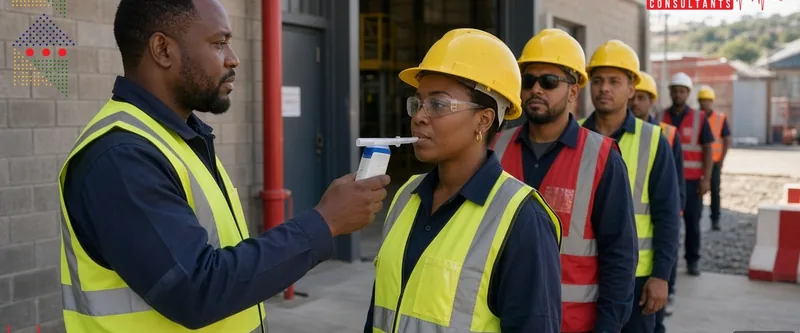
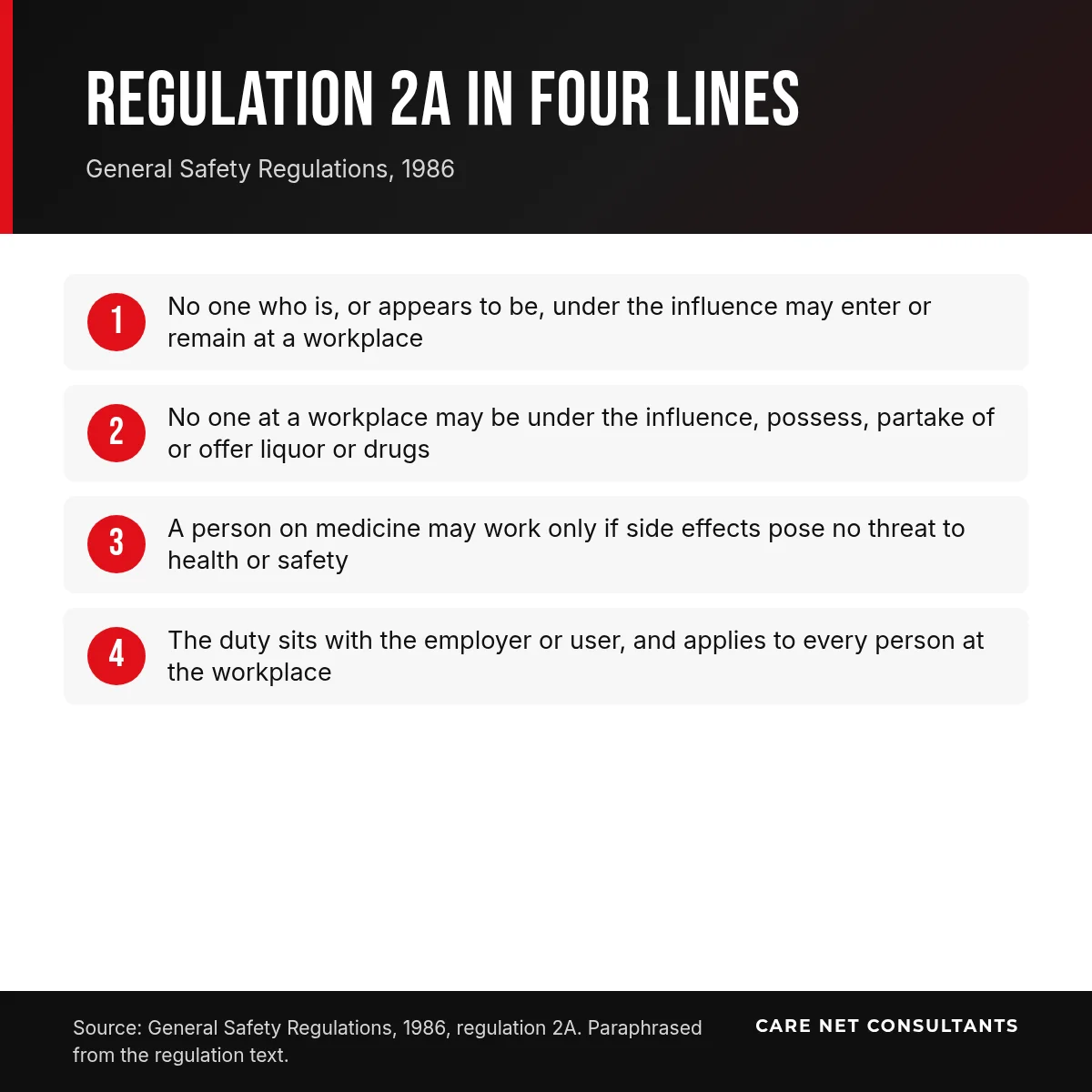
Short answer: Regulation 2A of the General Safety Regulations says an employer must not permit any person who is, or who appears to be, under the influence of intoxicating liquor or drugs to enter or remain at a workplace.[1] No person at a workplace may be under the influence, possess, partake of or offer others intoxicating liquor or drugs.[1] A workplace zero tolerance alcohol policy is therefore anchored in law, but the law is about being under the influence at work. A policy should be written to match that.
Fitness for work the next morning is an occupational health services question, not a party-planning one.
It is the third week of November. Somebody in HR has booked the venue, the caterer and a DJ. Somebody in safety has a question that no one wants to ask in a meeting: what happens if a person arrives at the plant on Monday morning still carrying Friday night?
Regulation 2A answers part of that. The part it does not answer is where employers get into trouble.
What regulation 2A says
The text is short enough to read in a minute.[1]
- 2A(1): Subject to subregulation (3), an employer or a user shall not permit any person who is or who appears to be under the influence of intoxicating liquor or drugs, to enter or remain at a workplace.
- 2A(2): Subject to subregulation (3), no person at a workplace shall be under the influence of, or have in his or her possession, or partake of, or offer any other person intoxicating liquor or drugs.
- 2A(3): Where a person is taking medicines, an employer or user shall only allow that person to perform duties at the workplace if the side effects of the medicine do not constitute a threat to the health or safety of that person or others.
Three phrases deserve a second look. "Appears to be" means the standard is how a person presents at the workplace, not only a laboratory result. "Possession" covers more than use. And subregulation (3) applies to prescribed or over the counter medicine too, which is a different conversation from alcohol or drugs.
What counts as a workplace
The Occupational Health and Safety Act defines a workplace as any premises or place where a person performs work in the course of his employment.[2] A year-end function at a restaurant is not obviously a workplace. A person who drives a company vehicle to it, or who is back on site two hours later, may be. If you are unsure how the definition applies to your function, take legal advice before the invitation goes out.
Where zero tolerance can go wrong
Many employers have a rule that any positive drug test is misconduct, whether or not the person was impaired at work. The Labour Appeal Court looked at exactly that kind of rule in Enever v Barloworld Equipment South Africa (JA86/22) [2024] ZALAC 12, decided on 23/04/2024.[3] The court found that dismissing an employee for testing positive for cannabis consumed off duty, under a blanket zero tolerance policy, was unfair discrimination under the Employment Equity Act and an automatically unfair dismissal, and ordered 24 months' compensation.[3]
The reasoning matters. According to a law firm summary, the court said a policy that effectively bars off-duty use must have a rational link to health and safety in the job concerned. It also recognised that the position is different for people who report for duty intoxicated, who use cannabis at work, or who operate heavy or dangerous machinery.[4]
Do not read that as permission for intoxication at work. Regulation 2A still applies, and an employee who is intoxicated at work can still face discipline. Read it as a reason to write your policy around impairment and job risk, not around a blanket result.
What a sound policy covers
You do not need a legal essay. You need a page that answers these questions in clear wording.
- Who is covered? Employees, contractors, visitors and anyone else at the workplace, as regulation 2A(2) says "no person".
- What is prohibited? Being under the influence at work, possessing, using or supplying alcohol or drugs at work, as the regulation sets out.
- How is "appears to be" assessed? Name who may act on observation, and how it is recorded fairly.
- What about medicine? Ask workers to tell their manager, or the health practitioner, if a prescribed medicine could affect safe work, as 2A(3) requires you to consider.
- How is testing used? If you test, say when, how and why. Section 7 of the Employment Equity Act prohibits medical testing unless legislation permits or requires it or it is justifiable in light of medical facts, employment conditions, social policy, fair distribution of employee benefits or the inherent requirements of a job.[5]
- What happens next? Describe the steps after a positive observation or test, including a safe way home.
Where Care Net fits
Our medicals offer drug strip tests, multi-drug screening and multi-drug cup tests with chain of custody as add-ons at additional cost, where the job risk calls for them.[6] We do not write your policy, and we will not tell you that a test can prove impairment on its own. We run the test you decide on, and we keep the record.
Before the function
- Send a short reminder of the policy before the event.
- Arrange safe transport home.
- Brief supervisors on what to do if a worker appears impaired on Monday.
- Keep the tone adult. People know what a year-end function is.
A good policy is not about catching anyone. It is about knowing in advance what you will do.
Questions people ask
What does regulation 2A of the General Safety Regulations say?
An employer or user shall not permit any person who is or who appears to be under the influence of intoxicating liquor or drugs to enter or remain at a workplace. No person at a workplace may be under the influence of, possess, partake of or offer others intoxicating liquor or drugs.
Does regulation 2A cover medicine?
Subregulation 2A(3) says an employer may only allow a person taking medicines to perform duties if the side effects do not constitute a threat to the health or safety of that person or others.
Can an employer dismiss for any positive cannabis test?
Not automatically. In Enever v Barloworld Equipment South Africa (JA86/22) [2024] ZALAC 12, decided on 23/04/2024, dismissal under a blanket zero tolerance policy for off-duty cannabis use was found to be unfair discrimination. The court recognised a different position for intoxication at work and for heavy machinery.
When may an employer test employees for drugs?
Section 7 of the Employment Equity Act prohibits medical testing unless legislation permits or requires it or it is justifiable in light of medical facts, employment conditions, social policy, fair distribution of employee benefits or the inherent requirements of a job.
Sources
Accessed on 09/10/2026.
- General Safety Regulations, 1986, regulation 2A Intoxication (Acts Online)
- Occupational Health and Safety Act 85 of 1993, section 1 definitions (gov.za)
- Enever v Barloworld Equipment South Africa, A Division of Barloworld South Africa (Pty) Ltd (JA86/22) [2024] ZALAC 12 (23/04/2024) (SAFLII)
- Pinsent Masons: South African court highlights need for rational zero-tolerance cannabis policy (03/06/2024)
- Employment Equity Act 55 of 1998, section 7 Medical testing (Acts Online)
- Care Net Consultants: Fixed clinics and what every medical includes
This article is general information for employers and is not legal or medical advice. Read the regulations for the full requirements and speak to a qualified practitioner about individual health concerns.
← Back to all articles