The Firebreak.
What we built in winter so that spring holds. POPIA in medical surveillance, how to verify a Certificate of Fitness in under a minute, and the new website. Your Partner in Workplace Health.

01 · The Partnership Statement
The Firebreak.
Voorsorg is beter as nasorg.
Afrikaans proverb. Precaution is better than aftercare.
Before the August winds arrive, a Highveld farmer burns a bare strip around the land. A firebreak. It costs diesel and labour, and in June it looks like ground wasted. Then the wind turns, a veld fire comes over the ridge, and it stops where the bare ground begins. The work was never visible in the season it was done. It became visible in the season it was needed.
We have spent our winter cutting a firebreak around your workers' medical records. Some of it has added a step to your day, or asked for a login you did not need before. We understand the frustration. Security is like insurance: you pay for it so that on the day it matters, you are covered. And on that day you will be glad you partnered with a company that took it seriously.
Spring starts here. Our new website opened on 1 September, and from now until February 2027 every newsletter carries one honest update on what we changed, why, and how it protects you.
02 · From the Managing Director
MCO and POPIA: what we have built, why it matters, and where we are going.
Barteld Bakker, Founder and Managing Director. The first of a monthly series that runs to February 2027.
There is a truth that has become impossible to ignore in 2026. The world is producing more data than at any point in human history, and it is also stealing more of it than at any point in human history.
Last year, South Africa ranked among the most targeted countries on the African continent for cybercrime. Medical and health data remains the most valuable category of stolen information on the dark web, fetching prices that dwarf stolen credit card details, because medical records do not expire. A stolen bank card can be cancelled. A stolen health record carries a person's chronic conditions, medication history, and fitness for duty status for life.
For our clients, this is not an abstract concern. Your workers' occupational health records sit at the intersection of employment law, privacy law, and personal dignity. A breach is not simply a regulatory failure. It is a betrayal of the people who trust you with their bodies and their livelihoods.
This is the context in which I want to tell you what we have been building.
The weight of the data we hold
Care Net Consultants processes occupational health assessments across four fixed clinics and sixteen mobile units, serving industries from construction and mining to food handling and transport. Every assessment generates a clinical record: hearing test results, lung function readings, blood pressure, vision, glucose, the full picture of a worker's occupational fitness at a point in time.
Multiply that across thousands of workers, dozens of clients, and fourteen years of operation, and you begin to understand the weight of what we hold on behalf of the people we serve.
We did not take that weight lightly before. But the truth is that the tools available to us two years ago were not adequate for the threat environment of today. My Clinic Online, which we built and own outright, has been systematically redesigned from the inside out to address that gap. Not to tick a regulatory box. Because it is the right thing to do for your workers and for you. Securing worker records for forty years is something a partner takes very seriously. We do fail at times, and we promise to always take feedback and improve.
What POPIA requires and what it actually means
The Protection of Personal Information Act came into full effect in July 2021. Most South African businesses treated it as a compliance project: draft a policy, appoint an information officer, file a notification with the Regulator, and move on.
We treated it as a design problem.
POPIA, at its core, establishes eight conditions for the lawful processing of personal information. The two that matter most in the occupational health context are consent and purpose limitation. A worker's medical information may be collected with their informed consent, and not otherwise. It may be used for the specific purpose for which it was collected, and for nothing else. It may be held for as long as necessary and no longer. And it must be protected with appropriate security measures.
That sounds straightforward. In practice, it requires completely rethinking how a medical record is created, stored, accessed, and eventually destroyed.
What we have changed in My Clinic Online
Digital consent at the point of assessment
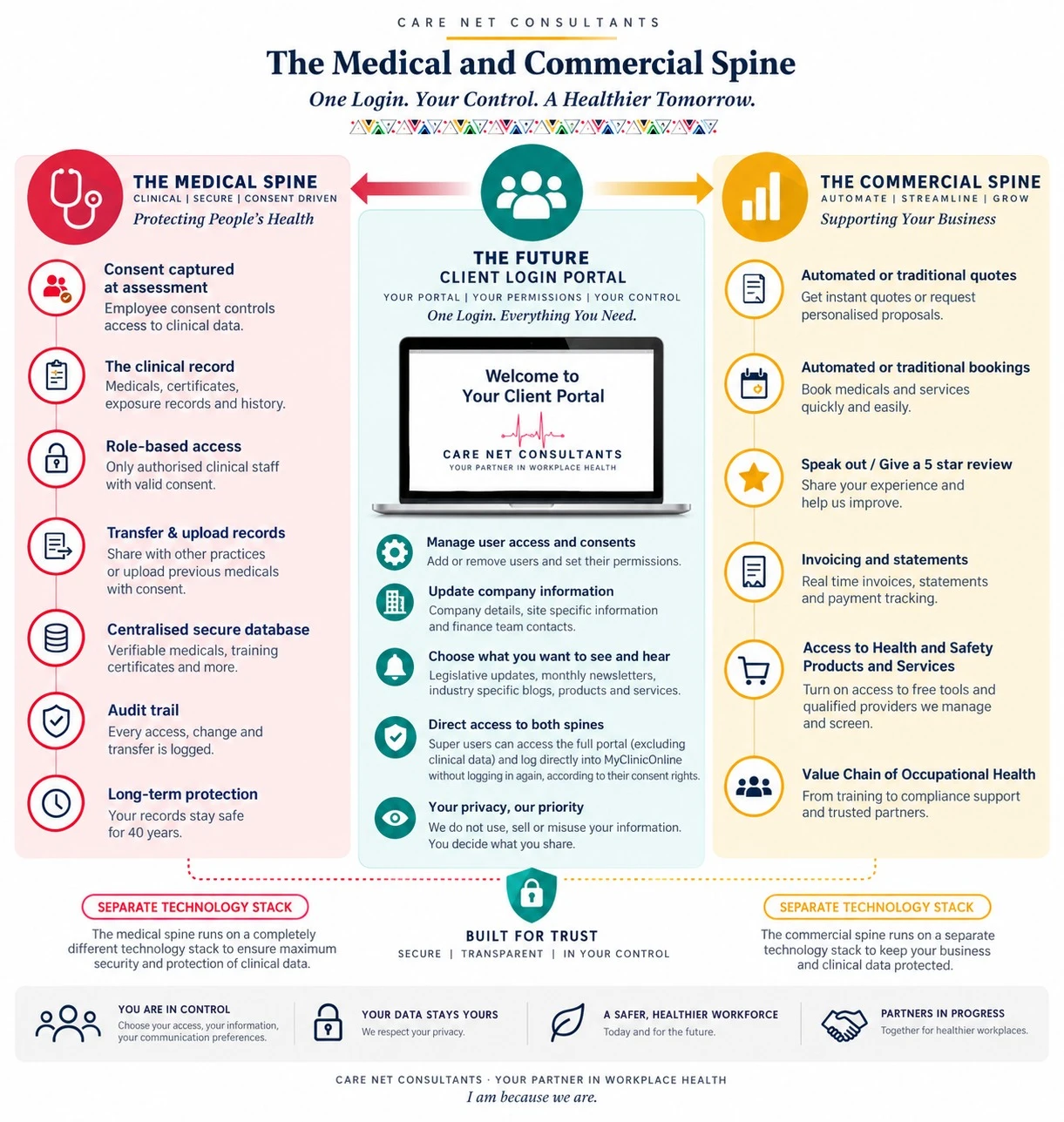
Previously, worker consent for medical data processing was captured on paper consent forms, which were filed, scanned, and stored separately from the clinical record. Under the new MCO architecture, consent is captured digitally at the point of assessment, linked directly to the worker's record, and time stamped. If a worker's data is ever queried under a POPIA access request or an audit, the consent record is immediately retrievable. No paper trail to hunt down. No filing cabinet to search. The record is the consent, and the consent is the record.
This matters for you as an employer because your exposure under POPIA is shared. If your service provider cannot demonstrate that your workers consented to their data being processed, the liability does not sit with us alone.
Role based access control
Not everyone who works at Care Net Consultants needs to see every record. Under our updated access architecture, clinical records are accessible on a strict need to know basis, determined by role and by client assignment. A practitioner at the Brackenfell clinic cannot access records from the Midrand clinic unless that access is specifically authorised. An administrator processing a booking cannot view the clinical findings. The principle is minimum necessary access, which is the standard POPIA and global data protection frameworks require.
Audit trail and access logging
Every access to a worker's record in My Clinic Online is now logged: who accessed it, when, from which device, and what action was taken. If a record is viewed, downloaded, or modified, that event is captured. This serves two purposes. First, it allows us to detect anomalous behaviour early. Second, it gives you, as the client, a complete and verifiable access history if a worker ever raises a complaint or a regulator ever asks.
Expiry alerts and certificate integrity
A medical fitness certificate that has expired is worse than no certificate at all. It exposes the employer to liability under the OHS Act if an unfit worker is harmed. MCO now alerts the Care Net client team and, where configured, the worker directly, when a certificate is within 30 days of expiry. No certificate expires unnoticed. No audit catches you short.
Data minimisation in reporting
Clients are entitled to know whether a worker is fit, conditionally fit, or referred. They are not entitled to the specific clinical findings that informed that determination, which are confidential to the worker and the treating practitioner without the necessary consent. Our report architecture has been restructured so that client facing outputs contain the data the client is permitted to receive, and nothing more. The clinical detail stays in MCO, accessible to the clinical team and to the worker, and is not transmitted to the employer as a matter of course.
What is in the pipeline
We are not finished. These enhancements are in development and will be released in the months ahead.
Worker data access requests (POPIA Section 23)
Under Section 23 of POPIA, every person has the right to request access to their personal information held by an organisation. Workers will soon have access to a worker app where they can view their own clinical information in confidence.
Automated data retention management
POPIA requires that personal information be retained for as long as necessary for the purpose for which it was collected, and no longer. We are building an automated retention engine within MCO that will flag records for review when the relevant retention period has elapsed, based on the type of assessment, the industry, and the applicable legislative retention requirement. This removes the single most common POPIA compliance failure: records held indefinitely because no one remembered to delete them.
Two factor authentication on the client portal
In a world where credential theft is the most common entry point for a data breach, a username and password alone is no longer sufficient. Two factor authentication is available on the MCO client portal today, and I would encourage every client to switch it on now: a code sent to a registered device or an authenticator application, alongside your password. Over the months ahead it will become a requirement for every login as the portal moves to fully encrypted access.
Quotes and bookings that know who you are
We are also building solutions to improve our service delivery. Quote automation and booking automation are both in beta. They will save you a great deal of time: once you have authenticated yourself, most of your details pre-populate, and your service level agreement is pulled through so that we are accurate when we quote you, or when you hold a group agreement with us.
Why this is about more than compliance
I have been in occupational health long enough to remember when a worker's medical record was a cardboard folder in a filing cabinet. I have watched that record move to a spreadsheet, then to a basic database, and now to a platform that can tell you, in real time, which of your workers across all your sites are due for reassessment in the next ninety days.
At every step of that journey, the fundamental question has not changed. Who is responsible for what is in that record? Who is responsible for keeping it safe? Who is responsible for using it honestly and for the purpose the worker agreed to when they gave their consent?
The answer has also not changed. We are. Together.
That is what partnership means in practice. Not a service level agreement. Not a vendor relationship. A shared commitment to the people whose data we hold and whose health we are entrusted to protect.
My Clinic Online is the infrastructure of that commitment. POPIA is the legal framework. But the reason we are doing this, the real reason, is that the workers who come through our clinics and our mobile units deserve to know that their most personal information is handled with the same care and dignity with which we conduct their assessments.
That is the standard we are building toward. And we are not done yet. Expect updates, and a full digital transformation that will in time include solutions to manage employee health and wellness. Look out for it.
Warm regards,
Barteld Bakker
Founder and Managing Director, Care Net Consultants
Your Partner in Workplace Health
03 · Operations Update
Protecting information without slowing you down.
Petrus van Zyl, Operations Director.
At Care Net Consultants, we remain focused on continuously improving our service, communication, and turnaround times across our clinics and mobile operations.
As POPIA continues to shape how personal information is managed, the protection of medical and occupational health information is receiving increasing attention. With additional health information regulations introduced in 2026, the way sensitive information is accessed, processed, and shared has become an increasingly important aspect of occupational health.
We understand that these additional controls can sometimes create frustration or add an extra step when information is required urgently. However, these safeguards are there for good reason. Medical information is highly personal and confidential, and protecting an employee's privacy is ultimately in everyone's best interest.
Our challenge is to find the right balance: protecting employee information and meeting our legal and regulatory responsibilities, while still making occupational health services as simple, efficient, and accessible as possible for our clients.
As we approach the final quarter of the year, we also encourage employers to review their occupational health programmes and ensure that all required periodic medical surveillance is up to date. Addressing outstanding medicals early can help prevent unnecessary pressure towards year end and ensure continued compliance.
Our focus remains simple: to continuously improve our service, protect the information entrusted to us, and provide our clients with a professional, efficient, and dependable occupational health service they can rely on.
Kind regards,
Petrus van Zyl
Operations Director
Before the fourth quarter arrives
Sections 8 and 9 of the Occupational Health and Safety Act (No. 85 of 1993) require employers to provide a working environment that is safe and without risk to health, and to conduct periodic health assessments for workers exposed to occupational hazards. Clients in manufacturing, mining, and transport are often audited in the fourth quarter. September is the right month to confirm that periodic assessments are current and that the records behind them are complete and defensible. My Clinic Online stores and retrieves those records instantly, so an audit request becomes a download rather than a search.
Two reminders that apply across industries. Food handling workers require regular audiometric and vision assessments, and the certificates behind them need to be current, not merely on file. Construction and manufacturing workers exposed to silica, dust, or fumes require lung function assessment by spirometry, and where noise is present, audiometry, with the baseline on record before periodic comparison is possible.
04 · 1 September
A new front door, opened on Spring Day.
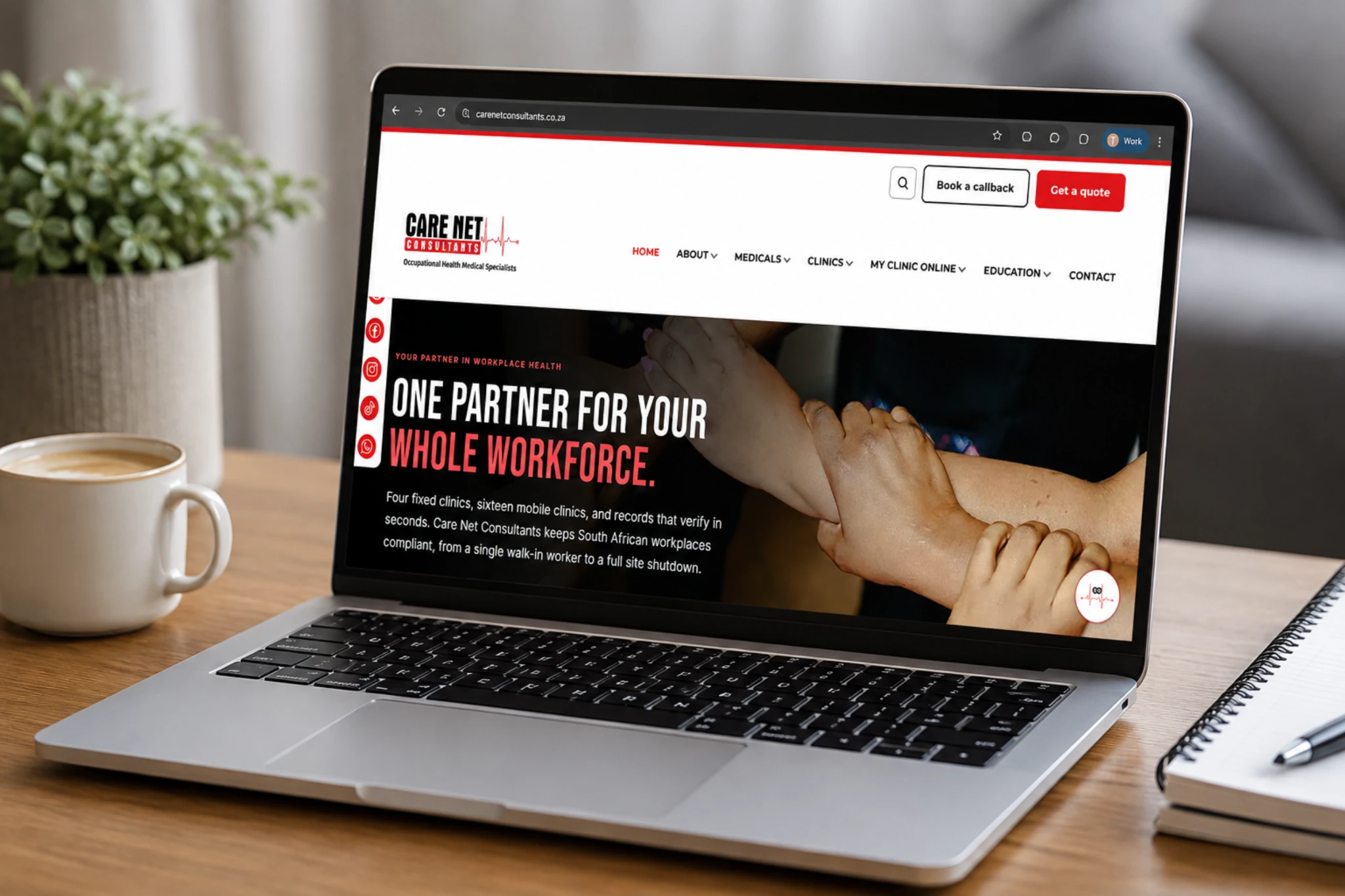
Spring Day was also launch day for our new website. It was built for the same reason the rest of this edition exists: to put useful things within reach. On carenetconsultants.co.za you will now find free guides and tools, and access to the legislation that governs your medical surveillance programme. Like anything planted in spring, it will keep growing through the year. Tell us what you want to see there.
05 · My Clinic Online
Protect your business by verifying Certificates of Fitness.
Tanya Nel, Director, People and Growth.
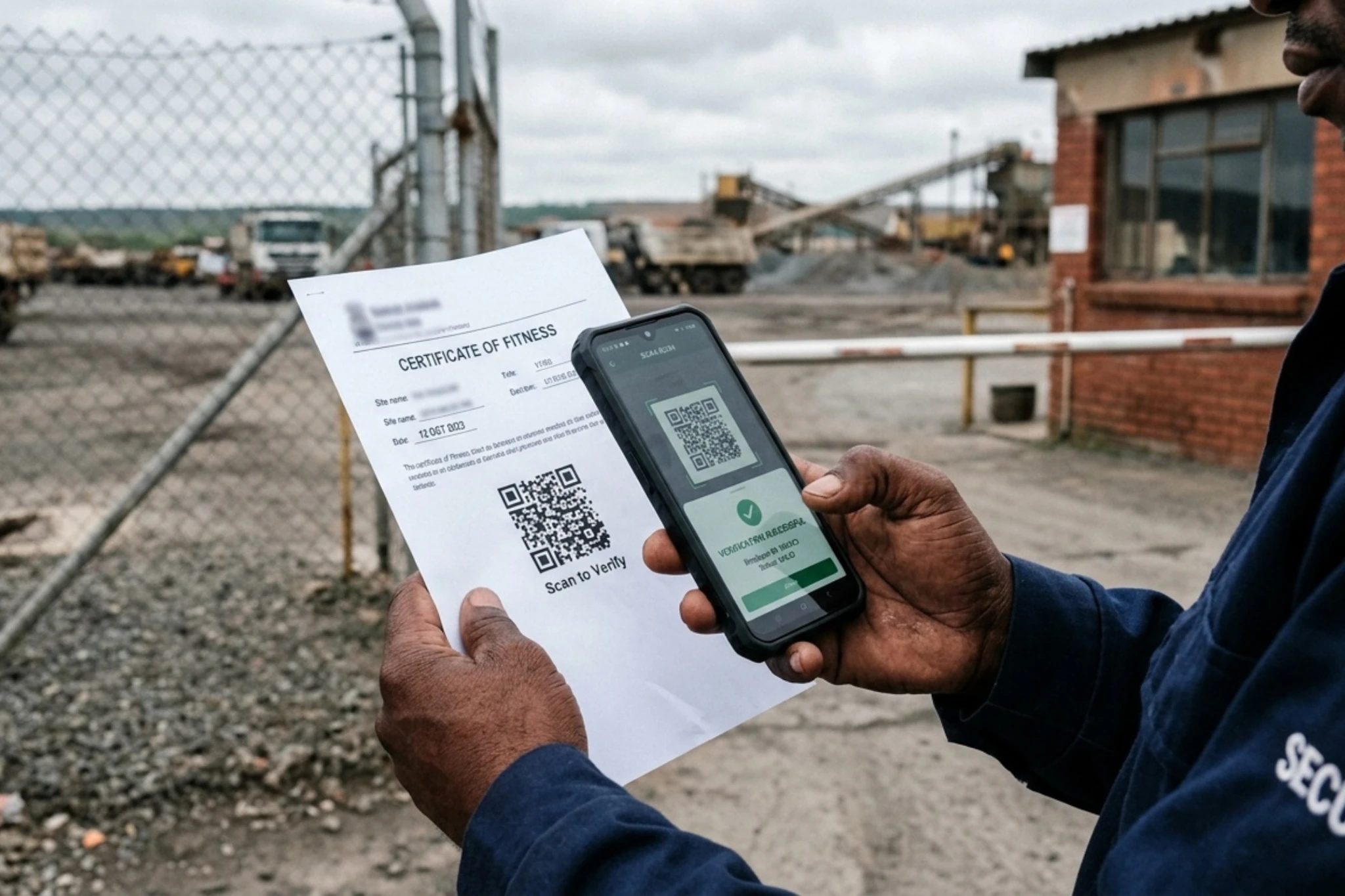
We have become aware of syndicates operating in Gauteng that are selling fraudulent medical reports and Certificates of Fitness. We therefore encourage clients to verify certificates before accepting them for site access or employment purposes.
This is particularly important when making use of subcontractors. You want to ensure that every person entering your workplace has a valid and accurate Certificate of Fitness appropriate to the work they will be performing. An invalid or fraudulent certificate could place that person, your employees, and your workplace at unnecessary risk.
Verifying a Care Net Certificate of Fitness is quick and easy
- Scan the QR code on the Certificate of Fitness with any phone camera.
- Or visit the My Clinic Online Certificate Verification page and enter the certificate number shown on the certificate: app.mycliniconline.co.za/verify
- Email us at queries@carenetconsultants.co.za if you would like our team to assist you in verifying the authenticity of a certificate.
The verification page shows the worker's name, photograph, fitness status, and validity period against a unique certificate reference number. No identity number is displayed, in line with POPIA, so the page can be checked at a site gate without exposing personal information.
We recommend making certificate verification part of your standard onboarding, subcontractor management, and site access processes.
A certificate may look legitimate. Take a moment to verify that it is.
Tanya Nel, Director, People and Growth
If you are uncertain about a Care Net medical certificate for any reason, please contact us. We would much rather assist you with verification than have your business or workplace exposed to unnecessary risk.
06 · September Awareness Calendar
September in the workplace.
Source: National Department of Health 2026 Health Awareness Calendar.
Three of these belong on your site, not on a poster
Heart Awareness Month. Blood pressure is measured at nearly every periodic assessment we conduct, and it is the reading most often flagged. High blood pressure has no symptoms a worker can feel, which is why it is picked up at a medical rather than reported at the clinic door. If your assessment reports show a rising share of conditionally fit outcomes tied to blood pressure, that is a workforce signal, not a string of unrelated cases, and it is worth a conversation with our clinical team about what a wellness intervention could look like.
Deaf Awareness Month. Noise induced hearing loss is permanent, cumulative, and entirely preventable. Audiometry at baseline and at each periodic assessment is how a shift is caught early, before it becomes a claim. Hearing protection that is issued but worn incorrectly, or removed for conversation in the noise zone, does not protect. September is a good month to walk the noise zones and look.
Eye Care Awareness Month. Vision assessment is often treated as the quick part of a medical, but for drivers, forklift operators, crane operators, and anyone reading gauges or fine print under poor light, it is the part that decides whether they are safe at the controls. A worker whose vision has changed since baseline needs to know, and so does the person who allocates their duties.
World Suicide Prevention Day falls on 10 September. Mental health at work is not an assessment outcome, and we do not pretend it is. It is a culture. The most useful thing an employer can do this month is make sure that every worker knows where to turn, and that turning there carries no penalty.
Educational spotlight: why accredited training is not interchangeable with generic training
Health and safety training is easy to buy and hard to defend. The difference sits in accreditation. Training delivered under a SETA accredited provider is assessed against registered unit standards, moderated, and recorded on the National Learner Records Database. A generic course, however well presented, produces an attendance certificate and nothing behind it.
That distinction matters in three places. In a Department of Employment and Labour inspection, where the inspector asks not whether training happened but whether it was competent. In an incident investigation, where an employer who can show accredited, recorded competence is in a materially different position from one who can show a sign in sheet. And in the Compensation Fund, where the employer's record of due diligence shapes the outcome. Care Net Consultants offers MSHEQ SETA accredited health and safety training for exactly this reason. Ask your account manager for the September and October training calendar.
A note on assessing women in industrial work
Many reference values used in occupational health were built on male working populations. Lung function norms, protective equipment sizing, manual handling limits, and heat stress thresholds all carry that history. When a female worker in construction, food handling, or manufacturing is assessed against a male default, the result can be a fitness decision that is technically complete and practically wrong. Our practitioners apply sex specific reference ranges where they exist and fit test protective equipment on the person wearing it. If you employ women in physically demanding or exposure heavy roles, ask us to review whether your programme reflects that.
Non diagnostic notice. The health information in this newsletter is educational. It does not diagnose any condition and does not replace an assessment by an occupational health practitioner. Fitness decisions for any worker are made by a registered practitioner on the basis of an assessment.
07 · Something for the Kitchen
The Care Net Spring Health Cocktail.
Winter tonics are for surviving. This one is for waking up. Orange and carrot for vitamin A and C, fresh ginger and turmeric because they have earned their reputation, black pepper because turmeric does very little without it, lemon and mint for the taste of a new season. Set the number of glasses and the quantities adjust for the office kitchen or the site canteen.

08 · Speak Out
Your voice shapes the service.
At Care Net Consultants, we believe that every client voice shapes the service we deliver. If something is not working, we want to know. If you have a suggestion that would make your experience better, tell us. If your workforce has a health need we are not yet meeting, speak to us.
This is not a complaints process. It is a partnership conversation. We have created a dedicated, confidential channel for client feedback and we treat every input as a priority.
This month in particular, we would value your honest view on the new information controls in My Clinic Online. If a safeguard has slowed you down at a moment when you needed information urgently, tell us where. We cannot remove the firebreak, but we can make sure the gate through it is in the right place.
Barteld Bakker, Founder and Managing Director
09 · This Month's Actions
Four things worth doing in September.
September and October decide whether a year ends cleanly. Here is where to start.
Primary Action
Verify that your medicals are legal
Check every Certificate of Fitness on your site, especially those presented by subcontractors, against the My Clinic Online verification page.
Secondary
Get a quote before the fourth quarter
September and October are the busiest months for periodic assessments and compliance audits. Book now and your workers are seen before the rush.
Also this month
Switch on two factor authentication
It is available on your MCO client portal today. Ask our client success team if you would like a hand setting it up.
Also this month
Get sector specific news
Our industry newsletter carries occupational health updates by sector: construction, mining, manufacturing, food handling, and transport.
10 · POPIA-Compliant Signup
Industry updates, tailored to your sector.
We are releasing industry-specific newsletters. The latest occupational health updates, legislative changes, and training video resources you can share with your employees.
Pick your industries
 Construction
 Food Handling
 Agriculture & Abattoir
 Manufacturing & Engineering
 Transport & Warehousing
 Cleaning, Hygiene & Recycling
 Telecommunications
 Safety & Security
 MiningPublic Sector
What you want to receive
Single opt-out at any time. We do not sell, share, or repurpose your data. Our full POPIA notice is on our website.
11 · Closing
Ready for the season ahead.
The fourth quarter is the busiest stretch of our year, and yours. September and October bring the periodic assessments, the audits, and the site inspections that decide whether a year ends cleanly. We are ready for it. Our clinics, our mobile units, our teams, and My Clinic Online have all been prepared through the winter for exactly this.
Thank you for choosing us in a competitive market. That choice is not taken lightly, and it is not taken for granted. We will keep earning it, one assessment, one certificate, and one honest update at a time. The next of those updates arrives in October.
Barteld Bakker
Founder and Managing Director, Care Net Consultants
Care Net Consultants
Your Partner in Workplace Health.