
Short answer: Under regulation 7(8) of the Construction Regulations, 2014, a contractor must ensure that every employee has a valid medical certificate of fitness, specific to the construction work to be performed and issued by an occupational health practitioner in the form of Annexure 3.[1] The employer fills in four columns of Annexure 3 before the medical: occupation, possible exposures, job specific requirements and protective equipment.[1] If those columns are blank or vague, the practitioner has nothing to test against.
Imagine the file at audit. Twenty certificates, all signed, all in date. Then someone reads the form beside the risk assessment and asks one question: why does the certificate for a scaffolder list the same exposures as the one for the site clerk?
That question is the one this article is about. A signed Annexure 3 is not the same as a useful one. Construction medicals and the Annexure 3 only work when the employer's half of the form is done properly. That is why we say construction medicals Annexure 3 forms deserve a second look before the team travels to the clinic.
What the regulation actually says
Regulation 7(8) is one sentence long. The certificate must be valid, specific to the construction work to be performed, issued by an occupational health practitioner, and in the form of Annexure 3.[1] The regulations define a "medical certificate of fitness" as the certificate contemplated in regulation 7(8).[1]
Other regulations repeat the demand for particular jobs. Tower crane operators need a certificate of fitness issued in the form of Annexure 3 (regulation 22). Operators of construction vehicles and mobile plant need one too (regulation 23(1)(d)(ii)). Workers on suspended platforms must be medically fit and hold a certificate of fitness (regulation 17(12)).[1]
The form itself
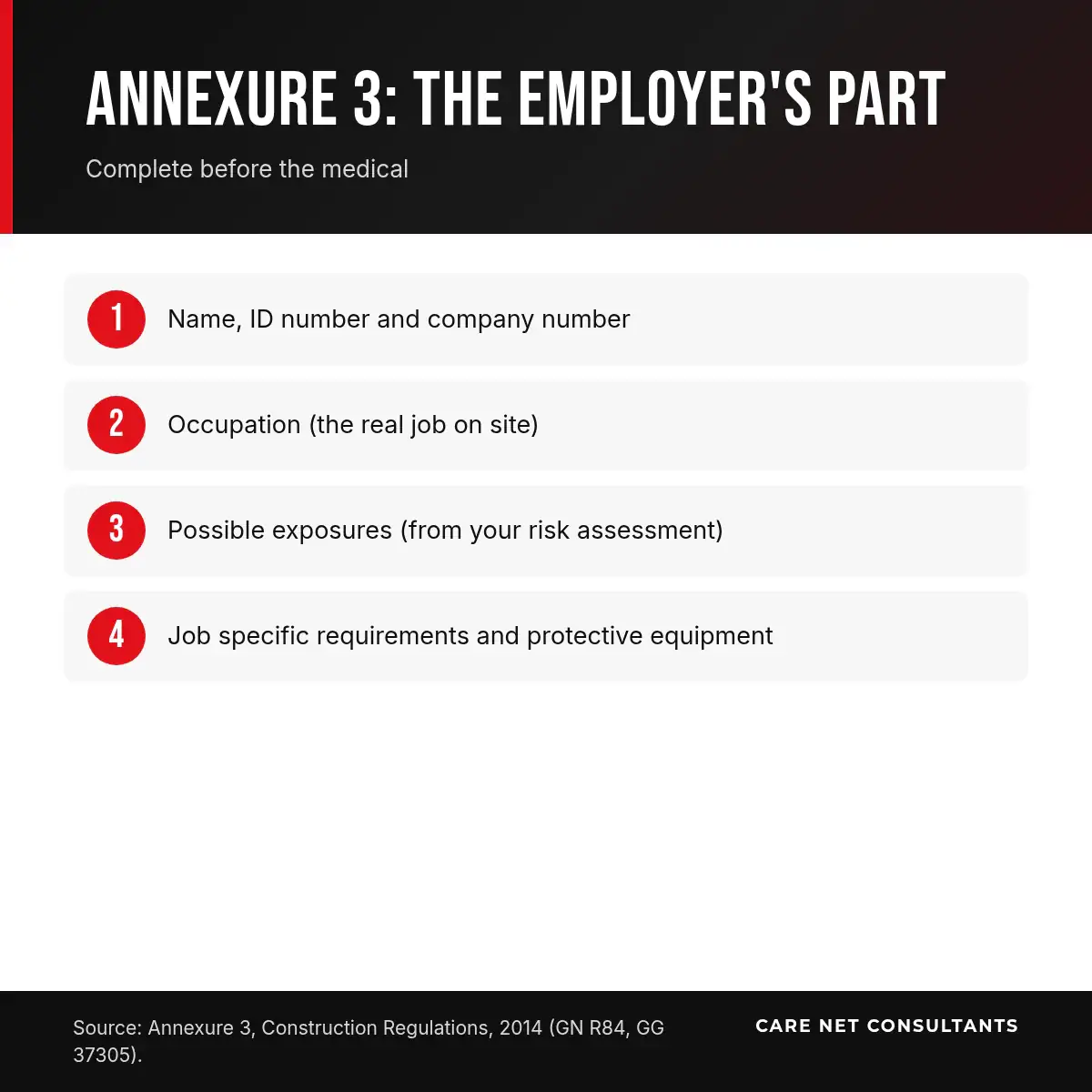
Annexure 3 is a single page headed "Medical Certificate of Fitness". At the top sit the employee's name, ID number and company number. Below is a grid, and a note that the employer must complete the information in the starred columns before sending the employee for a medical examination.[1]
The four starred columns are:
- Occupation, for example general worker, welder, bricklayer, steel fixer or mobile crane operator.
- Possible exposures, for example noise, heat, fall risk or confined space.
- Job specific requirements, for example operating a mobile crane, digging trenches, or erecting formwork and support work.
- Protective equipment, for example a dust respirator for light duty, or welding gloves.[1]
Those examples are printed on the form itself. Below the grid is the declaration: the examiner certifies that, by examination and testing against the criteria the employer specified, the employee is fit to perform the duties described in the grid. It carries the practitioner's name, signature, practice number, date and address.[1]
Read that declaration again. The practitioner certifies fitness against the criteria specified by the employer. The employer's columns are the test brief.
Why a blank grid fails
The form does not ask for a risk assessment. The regulations do, in regulation 9: a contractor must have risk assessments performed by a competent person before construction work starts and during it, as part of the health and safety plan.[1] Care Net's view, on our construction medicals page, is that the risks your assessment identifies are the same risks your Annexure 3 forms must declare, and that an inspector who reads both and finds they disagree has a finding.[2] That is our reading, not wording from the regulation.
In practice a gap shows up in a few predictable ways:
- The exposures column is copied for every worker, regardless of trade.
- The job specific column is empty for operators and people who work at a fall risk position.
- Protective equipment is left blank because "it is on site".
- The company number or ID number is missing, so the certificate cannot be linked cleanly to the file.
We will not say how often these happen, because we have no source for that. They are simply the places where the form leaves room for error.
What happens at the medical
Before the medical, the employer completes the form. The practitioner then tests against it and issues the certificate, including fit with restrictions or conditions where that applies.[2] Care Net's construction medicals follow four worker categories: general, working at heights, plant and cranes, and electrical. Each category needs a certificate and a completed Annexure 3.[2] Every medical includes an Annexure 3 risk-based exposure form and a review by an occupational health nursing practitioner (OHNP).[2]
The Annexure 3 PDF is available to download from our site. If you are sending a team, fill it in from your risk assessment and not from memory.
What the Act expects of the employer
The regulations sit under the Occupational Health and Safety Act, 1993. Section 8 requires an employer to provide and maintain, as far as reasonably practicable, a working environment that is safe and without risk to health.[4] Section 38 makes failure to comply with section 8 an offence. The Act sets the penalty at up to R50 000, up to one year in prison, or both.[4] A complete, accurate Annexure 3 is one of the simplest records an employer can keep to show it took those duties seriously.
The form also protects the worker. A certificate that says what the job involves and what protection it needs is a more honest record of fitness than one that says nothing. Regulation 10(2)(b) takes the same view for work at height. Fall protection plans must include the process for evaluating employees' medical fitness and the records of it.[3]
Five checks before the team goes to the clinic
- Does the occupation match what the person actually does on site, not the job title on the payslip?
- Do the exposures match your current risk assessment for this site?
- Is there a job specific requirement for every operator, crane or plant driver, and anyone who works from a fall risk position?
- Is the protective equipment column complete and realistic?
- Are the name, ID number and company number legible and correct?
None of this is complicated. Most of the information already exists in your risk assessment and your site file. Copying it into the right column is the cheapest part of a construction medical, and it is the part only the employer can do. If you would rather talk it through, a Care Net consultant will walk you through the form.
Questions people ask
What is an Annexure 3 medical certificate of fitness?
It is the certificate form in the Construction Regulations, 2014 that an occupational health practitioner issues after testing a worker against the criteria the employer specified for the job.
Who must ensure construction workers have a valid Annexure 3?
Regulation 7(8) says a contractor must ensure that all employees have a valid medical certificate of fitness, specific to the construction work to be performed, issued by an occupational health practitioner in the form of Annexure 3.
Which columns must the employer complete on Annexure 3?
Four starred columns: occupation, possible exposures, job specific requirements and protective equipment. The employer completes them before sending the employee for the medical.
Do tower crane operators and plant drivers need an Annexure 3?
Yes. Regulation 22 requires tower crane operators to have a certificate of fitness issued in the form of Annexure 3, and regulation 23(1)(d)(ii) requires the same for operators of construction vehicles and mobile plant.
Sources
Accessed on 09/10/2026.
- Construction Regulations, 2014 (GN R84, GG 37305, 07/02/2014), including Annexure 3 (gov.za)
- Care Net Consultants: Construction medicals
- Construction Regulations, 2014, regulation 10 Fall protection (Acts Online)
- Occupational Health and Safety Act 85 of 1993 (gov.za)
- Care Net Consultants: Fixed clinics and what every medical includes
This article is general information for employers and is not legal or medical advice. Read the regulations for the full requirements and speak to a qualified practitioner about individual health concerns.
← Back to all articles