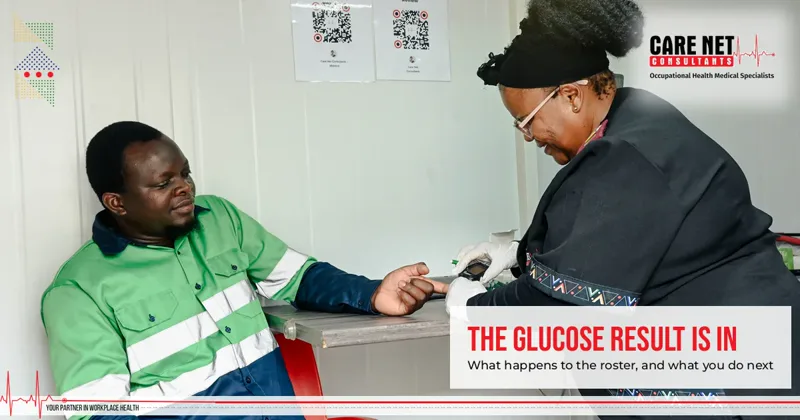
Short answer: A raised glucose reading at a workplace medical is a flag for follow up. It is not a diagnosis and it is not a fitness verdict. The 2017 SEMDSA type 2 guideline says bedside or point-of-care devices must not be used to diagnose diabetes, and that in someone without symptoms an abnormal laboratory result must be repeated on a separate day within a two-week period.[1] Care Net's recommendation is that the employer receives the fitness outcome and any conditions, not the glucose number.
The reading is in. The worker feels well. The afternoon shift still needs that person on the roster.
The useful question is not whether this is diabetes. The useful question is what you do next, so the worker gets a confirmatory laboratory test and the shift does not stall while you guess.
A flag, not a diagnosis
SEMDSA still lists its 2017 type 2 diabetes guideline on the Society's public guidelines page.[1][3]
- In someone with symptoms of high blood sugar (polyuria, polydipsia, blurred vision or weight loss), or with metabolic decompensation, a single laboratory test at or above the diagnostic threshold can confirm diabetes.
- In someone with no symptoms, one laboratory test is not enough. The same test category must be repeated on a separate day within a two-week period. The tests named are fasting plasma glucose of 7.0 mmol/L or more, a 2-hour post-load glucose of 11.1 mmol/L or more, or HbA1c of 6.5% or more.
- Bedside or point-of-care devices, for glucose or HbA1c, must not be used to diagnose diabetes.
- A random plasma glucose test is not a recommended screening test for people without symptoms. A random reading below 11.1 mmol/L does not exclude diabetes.
A finger-prick at a workplace medical is a flag. It is not a diagnosis and not a fitness decision, and it does not replace a laboratory or a treating doctor.
Who should see the number
When a workplace screening result is raised, a cautious sequence is:
- Tell the worker the result in private.
- Advise the worker to see their own doctor or clinic for a confirmatory laboratory test.
- The practitioner records the fitness outcome for the job. Where relevant, the certificate can carry conditions.
- Care Net's recommendation is that the employer receives the fitness outcome and any conditions, not the glucose reading.
Step 4 follows section 7 of the Employment Equity Act, which prohibits medical testing of an employee unless legislation permits or requires it, or it is justifiable.[6][7] A glucose check for a safety-critical role may be justifiable. Passing the raw number to a supervisor is not part of that justification.
How the roster stays intact
Shift rosters are where this gets practical. A worker who has diabetes and is on treatment may need regular meal breaks, or a conversation about overtime and night work. That is a discussion between the worker, their doctor and, where they choose, their manager.
We do not claim a diabetes diagnosis changes fitness for any given job. It depends on the person, the treatment and the work. A certificate can carry conditions. The practitioner who has seen the worker decides. Sending the worker home automatically is not a medical finding.
Put the process on one page
Write the process on one page: who is tested and why, how the result is explained, what the worker does next, and what the employer receives. Say that a raised screening result is health business, not a performance issue. Ask your provider, in writing, which roles include a glucose check and who reviews the file.
Four checks before the next medical
- Ask your provider whether glucose testing is part of the panel for each role, and why.
- Agree in writing who receives results and what they receive.
- Decide, with your team, how a raised result is followed up so that it does not cost anyone a day's pay.
- World Diabetes Day is 14 November 2026.[4] The campaign theme for 2026 to 2027 is Early action on diabetes.[5] If workers want a self-check, the campaign page offers the IDF type 2 risk test.[5]
None of this needs drama. A flag, a confirmatory test, a fitness outcome, and a roster that still runs.
Questions people ask
Is a workplace glucose test a diagnosis of diabetes?
No. SEMDSA guidance says bedside or point-of-care devices must not be used to diagnose diabetes, and that in someone without symptoms an abnormal laboratory result must be confirmed by repeating the same test category on a separate day within a two-week period.
What are the SEMDSA diagnostic thresholds for type 2 diabetes?
For a confirmed diagnosis in someone without symptoms, the 2017 guideline names fasting plasma glucose of 7.0 mmol/L or more, a 2-hour post-load glucose of 11.1 mmol/L or more, or HbA1c of 6.5% or more, repeated on a separate day within a two-week period.
Can an employer see a worker's glucose result?
Section 7 of the Employment Equity Act prohibits medical testing of an employee unless legislation permits or requires it, or it is justifiable. Care Net recommends that the employer receives the fitness outcome and any conditions, not the reading. That is a recommendation for employer education, not a description of every file.
What should happen to the shift roster after a raised result?
A raised screening result is a flag for a confirmatory laboratory test, not an automatic stand down. The practitioner records the fitness outcome for the job. Conditions on the certificate, if any, are what the roster should follow.
Sources
Accessed on 09/11/2026.
- SEMDSA Type 2 Diabetes Guidelines Expert Committee. The 2017 SEMDSA Guideline for the Management of Type 2 Diabetes. JEMDSA 2017; 22(1) Supplement 1: S1-S196 (KZN Health host)
- 2017 SEMDSA diabetes management guidelines (DeNovo Medica CPD host)
- SEMDSA: Guidelines (lists Management of Type 2 diabetes mellitus 2017)
- National Department of Health: 2026 Health Awareness Calendar
- World Diabetes Day: Early action on diabetes (IDF campaign)
- Employment Equity Act 55 of 1998 (gov.za)
- Employment Equity Act 55 of 1998 (Department of Employment and Labour host)
This article is general information for employers and is not legal or medical advice. Read the regulations for the full requirements and speak to a qualified practitioner about individual health concerns.
← Back to all articles