Watch the exposure, not only the first medical.
Medical surveillance is the programme that follows workers who may be exposed to hazards at work. It starts with a baseline, repeats on a cycle the risk requires, and ends with an exit medical. Care Net keeps the record for the period the law sets.
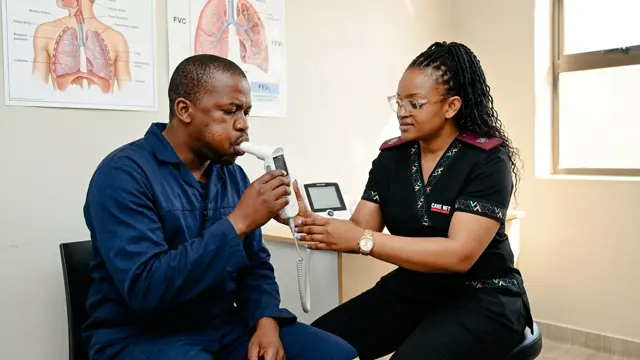

Come to us, or we come to you
Send one worker to a fixed clinic, or book a mobile clinic and run the medicals on your site with no travel time lost.
Midrand, Elandsfontein, Brackenfell and Gqeberha
Walk-in and booked medicals at full clinics in Gauteng, the Western Cape and the Eastern Cape.
See our fixed clinics 16 mobile clinics
Medicals on your site
A fully equipped mobile clinic comes to your site or camp. Large teams are tested in a planned window, including Saturdays.
See our mobile clinics
The problems a single certificate cannot solve

No trend to show the inspector
A drawer of unrelated certificates is not surveillance. We keep each worker's baseline, periodic and exit results in one digital record.

Panel does not match the agent
Noise needs audiometry. Hazardous chemical agents need the tests those agents require. We match the panel to the safety data sheets and the noise zones you declare.

Exit medical never done
When a worker leaves an exposure, the exit medical closes the file. Skipping it leaves you without a last reading if a later claim arrives.
Start or restart a surveillance programme
Send the job list, the agents and the noise zones. We confirm the cycle and the panel.

OHS Act, HCS and noise, on your floor
Medical surveillance is required when the risk assessment says the exposure can harm health and a medical test can find that harm early. Three instruments do most of the work on South African sites.
The duty to monitor
You must provide a working environment that is safe and without risk to health, so far as is reasonably practicable. Where exposure remains after controls, medical surveillance is how you watch for harm.
Start with a pre-employment medical. Repeat on the cycle the practitioner sets. Close with an exit medical when the person leaves the exposure.
The current HCS framework
These regulations replaced the older Hazardous Chemical Substances rules. They require risk assessment, exposure control, information and training, and medical surveillance where the agent and the exposure call for it.
Send the safety data sheets. Biological monitoring is added only when the agent and the job require it, at additional cost, and is confirmed before we start.
Read the 2021 regulationsThe current noise framework
Where workers are in a noise zone, you need a baseline audiogram and periodic tests that can be compared. Care Net hearing screening follows SANS 10083 so the readings sit on one standard.
Do not mix screening methods across years if you can avoid it. A comparable audiogram is the point of the programme.
Keep the record for the period the law sets
Some records are kept for 5 years. Medical surveillance records for hazardous exposure are kept for 40 years from the date of the last entry. Paper seldom survives that intact.
Your Care Net records sit in a secure, POPIA-compliant digital store for as long as the law prescribes, ready for audits and access requests.
How the programme is built
We take your industry, headcount and job descriptions. The panel is matched to the exposure: noise, hazardous chemical agents, dust, heat or height. Construction roles still need the Annexure 3 certificate of fitness as the legal form. Heights roles use the working at heights medical inside the same programme.
See the industry pages for the test matrix that applies to your workforce, including manufacturing and engineering, construction and mining.
