Spirometry lung function tests at work
Breathing tests matched to dust, fumes and the job.
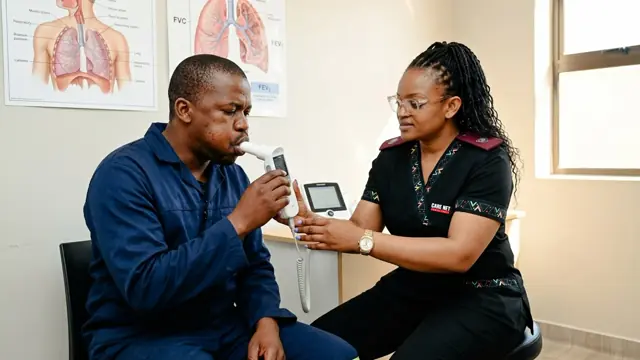
Spirometry measures how much air a worker can blow out, and how fast. Care Net uses it on occupational medicals where the risk assessment points to dusts, fumes or other airborne agents, then stores the result next to the baseline.

Come to us, or we come to you
Send one worker to a fixed clinic, or book a mobile clinic and run the medicals on your site with no travel time lost.
Midrand, Elandsfontein, Brackenfell and Gqeberha
Walk-in and booked medicals at full clinics in Gauteng, the Western Cape and the Eastern Cape.
See our fixed clinics 16 mobile clinics
Medicals on your site
A fully equipped mobile clinic comes to your site or camp. Large teams are tested in a planned window, including Saturdays.
See our mobile clinics
Breathing fine is not the same as testing fine

No baseline, no trend
A one-off blow does not show what changed. Surveillance keeps the first spirometry next to the later ones so a drop is visible.

The wrong panel for the dust
Noise needs audiometry. Airborne agents need lung function when the practitioner says so. We match the panel to the safety data sheets you send.

A used mouthpiece is not a shortcut
Every Care Net spirometry test uses a SANS approved antibacterial disposable mouthpiece, a single-use barrier filter, as already stated on our medical pages.
Book spirometry for the exposed crew
Send the agents and the headcount. We confirm whether lung function sits on the panel.

SATS, ATS and ERS, on a workplace medical
Care Net spirometry follows the South African Thoracic Society guideline, aligned to ATS and ERS. That is the same wording already used on Care Net industry pages. This page does not invent a new clinical method.
The numbers on the printout
FVC is the total volume blown out. FEV1 is the volume in the first second. The ratio is FEV1 divided by FVC. Our spirometry workplace note explains what those numbers mean on a workplace medical.
FVC is the total volume blown out. FEV1 is the volume in the first second. The ratio is FEV1 divided by FVC. Our spirometry workplace note explains those numbers in everyday words.
The occupational result goes on the certificate and the surveillance file. A diagnosis of lung disease belongs with the treating clinician.
When dusts and fumes sit on the panel
Where the risk assessment and the agent call for medical surveillance, lung function can be part of that panel. The practitioner confirms it from the exposures you declare.
Send the safety data sheets with the booking. Do not guess the panel from a previous site's invoice.
Baseline, periodic, exit
Put spirometry inside the medical surveillance programme. Repeat it on the cycle the practitioner sets, and close with an exit test when the person leaves the exposure.
A drawer of unrelated certificates is not a programme. My Clinic Online keeps the trend on one record.
Twelve lung notes on the blog
Start with a beginner's guide to lung function tests, asthma in the workplace, and protecting lungs at work. This service page is the booking door.
The blogs explain. The medical records the result.
Who we see for spirometry
Manufacturing and engineering crews, grain and milling roles, welders, and other workers whose risk assessment names airborne agents. Also new starters who need a lung baseline before they start. Further notes: reduced lung capacity, abnormal results, monitoring lung health, asthma and COPD at work, breathing techniques, environmental factors, sleep apnoea and lung function, nutrition for lung health, and lung cancer and occupational health.