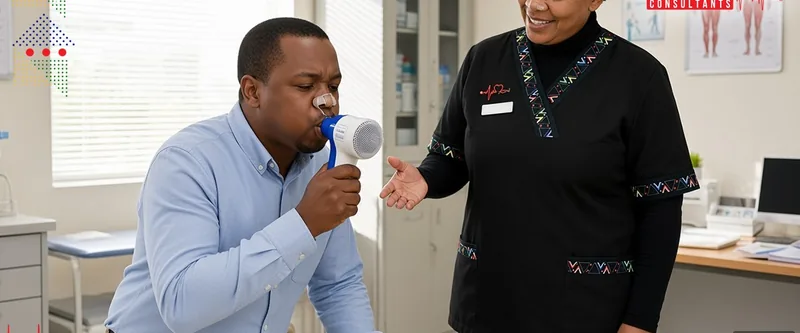
Short answer: A spirometry test workplace programme measures how much air a worker can blow out, and how fast. It uses three numbers: FVC (the total volume breathed out forcefully), FEV1 (the volume in the first second) and the FEV1/FVC ratio.[1] A worker can feel fine and still have a result that needs follow up. World COPD Day on 18/11/2026 has the theme "Early Diagnosis and Management for a Better Life", because under- and misdiagnosis are common.[2]
Ask a machine operator how his chest is. "Fine," he will say. He has said it for years.
Then he blows into a spirometer, and a printout arrives with numbers on it that neither of you can read. This article is about that printout. It is not about frightening anyone. It is about knowing what the test can and cannot tell you before World COPD Day.
Why the day matters to a manufacturer
The Global Initiative for Chronic Obstructive Lung Disease (GOLD) organises World COPD Day. The 2026 date is 18 November, and the theme is "Early Diagnosis and Management for a Better Life".[2] GOLD describes COPD as common, preventable and treatable, and says extensive under- and misdiagnosis leads to people getting treatment late.[2] It also says earlier treatment can slow progression, reduce symptoms and prevent future flare-ups.[2]
A note on the date. The Department of Health's 2026 awareness calendar lists World COPD Day on 19/11.[3] GOLD, as the organiser, sets it on 18 November, so we use 18/11/2026.
GOLD names routine spirometry as one way to improve diagnosis, and calls for better access to it.[2] That is the link to your plant.
When the law asks for lung testing
South African law does not say "test everyone's lungs". It ties medical surveillance to exposure. Under the Hazardous Chemical Agents Regulations, 2021, regulation 7, an employer must place an employee under medical surveillance if the employee may be exposed to an agent listed in Table 4 of Annexure 2, or if an identifiable disease may relate to the exposure and there is a reasonable likelihood it may occur, or if the occupational health practitioner recommends it.[4] An initial evaluation happens immediately before or within 14 days after starting work, and later examinations are at intervals not exceeding two years, or as specified by an occupational medicine practitioner.[4]
The guidance annexure to those regulations notes that medical testing can include tests such as spirometry (lung function).[4] What goes into the programme is decided from your risk assessment and your practitioner, not from a template.
What the spirometer measures
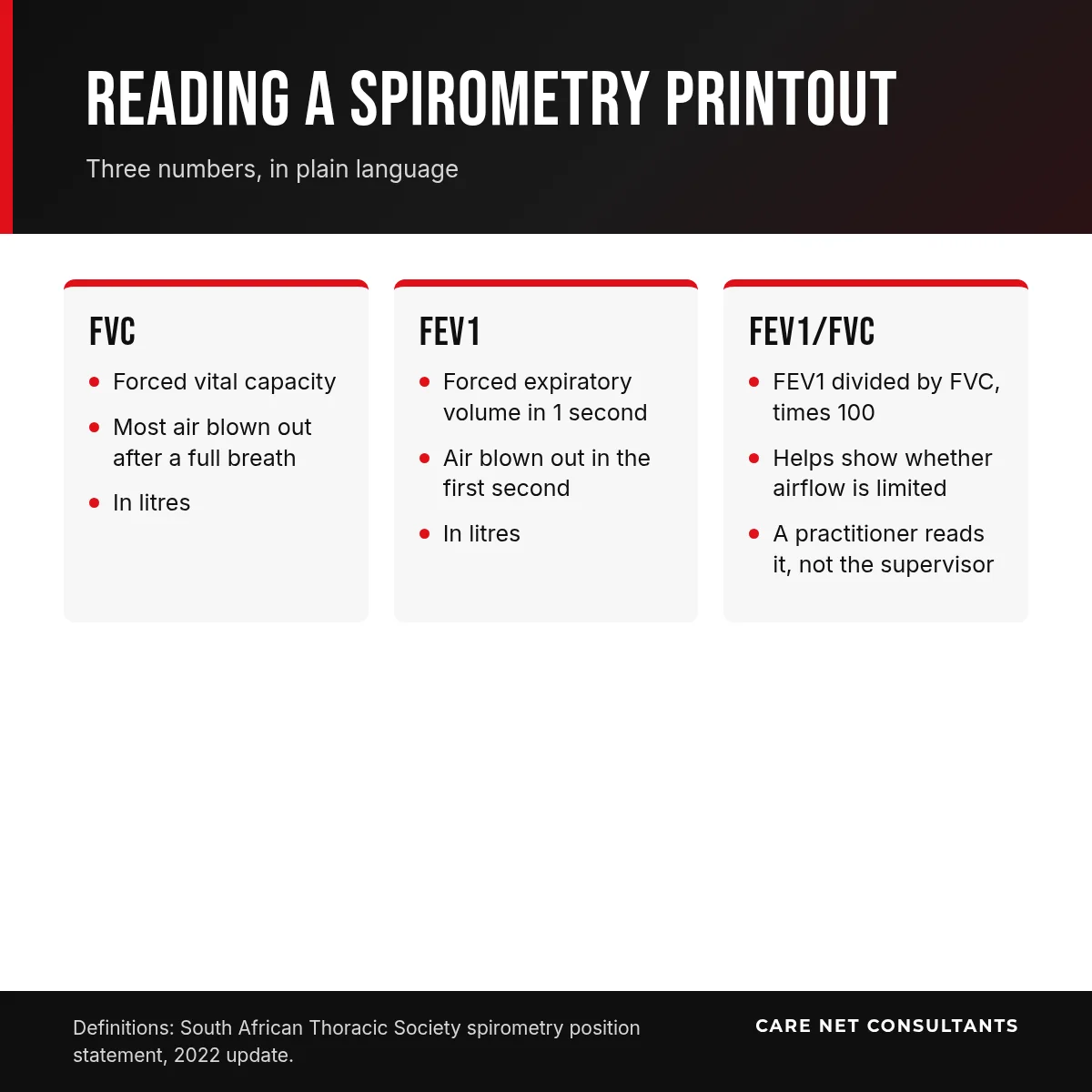
The South African Thoracic Society (SATS) position statement on spirometry sets out the definitions.[1]
- FVC (forced vital capacity): the maximum volume of air breathed out from a full breath, with a rapid, maximally forced effort. It is reported in litres.
- FEV1 (forced expiratory volume in one second): the volume breathed out in the first second of that effort.
- FEV1/FVC%: FEV1 divided by FVC, multiplied by 100. This ratio helps show whether airflow is limited.
The practitioner does not read the raw number alone. Results are compared with predicted values for a person of the same age, sex, height and ethnic group, so those details must be recorded on the day of the test.[1] SATS recommends the Global Lung Function Initiative 2012 equations for South Africa, and warns that inappropriate predicted values can produce falsely abnormal results in healthy people.[1]
On where to draw the line, SATS notes that a fixed cut-off of 80% of predicted has been challenged, and that the lower limit of normal (LLN) has better diagnostic accuracy. It adds that an FEV1/FVC ratio below 70% is still advocated by many, though it is a crude approach.[1] This is why a printout read by a layperson can mislead, in either direction.
Quality is part of the result
A spirometry result is only as good as the test. SATS asks that equipment be validated, that calibration be done daily, and that acceptability criteria be applied to each manoeuvre.[1] Care Net's own approach follows the SATS guideline, aligned to ATS and ERS, and uses a single-use barrier filter with each test.[5] A test is a skilled procedure. A worker who coughs at the start, or does not blow fully, can produce a number that means nothing.
What a result can do, and what it cannot
A spirometry result cannot diagnose COPD or any other lung disease on its own. It shows a pattern, and the practitioner decides if follow up with a doctor is warranted. A worker with a result outside the expected range should be advised to see his own doctor. A worker with a normal result should still report new symptoms.
For the employer, three practical points follow:
- Compare like with like. Baseline and periodic tests on the same equipment and method make trends meaningful.
- Keep the record. Medical surveillance reports must be retained for the periods the regulations set.[4]
- Do not read printouts on the floor. A supervisor with a printout is a privacy problem, and a poor interpreter.
Before 18/11
Look at your risk assessment. Which jobs involve dust, fumes or chemical agents that could affect the lungs? When did those workers last do spirometry, and was there a baseline? If you do not know, that is where to start.
The aim is a simple one. Nobody should find out from a bad day at 55 that a quiet change began at 35.
Questions people ask
What does a spirometry test measure?
It measures how much air a person can breathe out forcefully and how fast. The main numbers are FVC, the total volume exhaled, FEV1, the volume in the first second, and the FEV1/FVC ratio.
What is FEV1/FVC?
It is FEV1 divided by FVC, multiplied by 100. According to the South African Thoracic Society, it helps show whether airflow is limited, and is read together with FEV1 and FVC against predicted values.
Can spirometry diagnose COPD on its own?
No. Spirometry shows a pattern of lung function. A doctor decides on diagnosis, using the result with symptoms, history and examination.
When is World COPD Day in 2026?
GOLD, the organiser, sets World COPD Day on 18 November 2026. The 2026 theme is Early Diagnosis and Management for a Better Life. The Department of Health calendar lists 19 November.
Sources
Accessed on 09/10/2026.
- Position statement for adult and paediatric spirometry in South Africa: 2022 update (SATS, PMC)
- World COPD Day 2026 (GOLD)
- National Department of Health: 2026 Health Awareness Calendar
- Regulations for Hazardous Chemical Agents, 2021 (GN R280, GG 44348, 29/03/2021)
- Care Net Consultants: Manufacturing and engineering medicals
This article is general information for employers and is not legal or medical advice. Read the regulations for the full requirements and speak to a qualified practitioner about individual health concerns.
← Back to all articles