
Short answer: The Physical Agents Regulations, 2024 (GN 5952) set South Africa's rules for heat stress, cold stress and vibration, among other physical agents. They apply a limit, an action level where one exists, a risk assessment at least every 24 months, medical screening where the risk assessment calls for it, and 40 years of records.[1] They replaced the Environmental Regulations for Workplaces, 1987, which were repealed on 06/09/2026.[2][3]
Picture a packing shed at 14:00 in January. Or a tractor cab on a long day of ploughing, or a cold room that someone enters twenty times a shift. None of it looks like a hazard until you ask the right question: how much is too much?
Until recently, that question had a thin legal answer. It now has numbers, a method and a paper trail. If you run a farm team, the new rules deserve a look before the summer season starts.
What changed, and when
The Minister of Employment and Labour published the Physical Agents Regulations, 2024 as Government Notice 5952 in Government Gazette 52226 on 06/03/2025.[1] Regulation 21 repealed the Environmental Regulations for Workplaces, 1987 eighteen months after promulgation, which both Acts Online and the GRC Shop read as 06/09/2026.[2][3] A later notice, GN 7149 of 20/02/2026, corrected one provision and revised some tables. Heat stress was not among the changes.[4]
So for several months the two sets of rules overlapped. That has now ended, and the 2024 regulations stand alone.
The numbers that matter on a farm
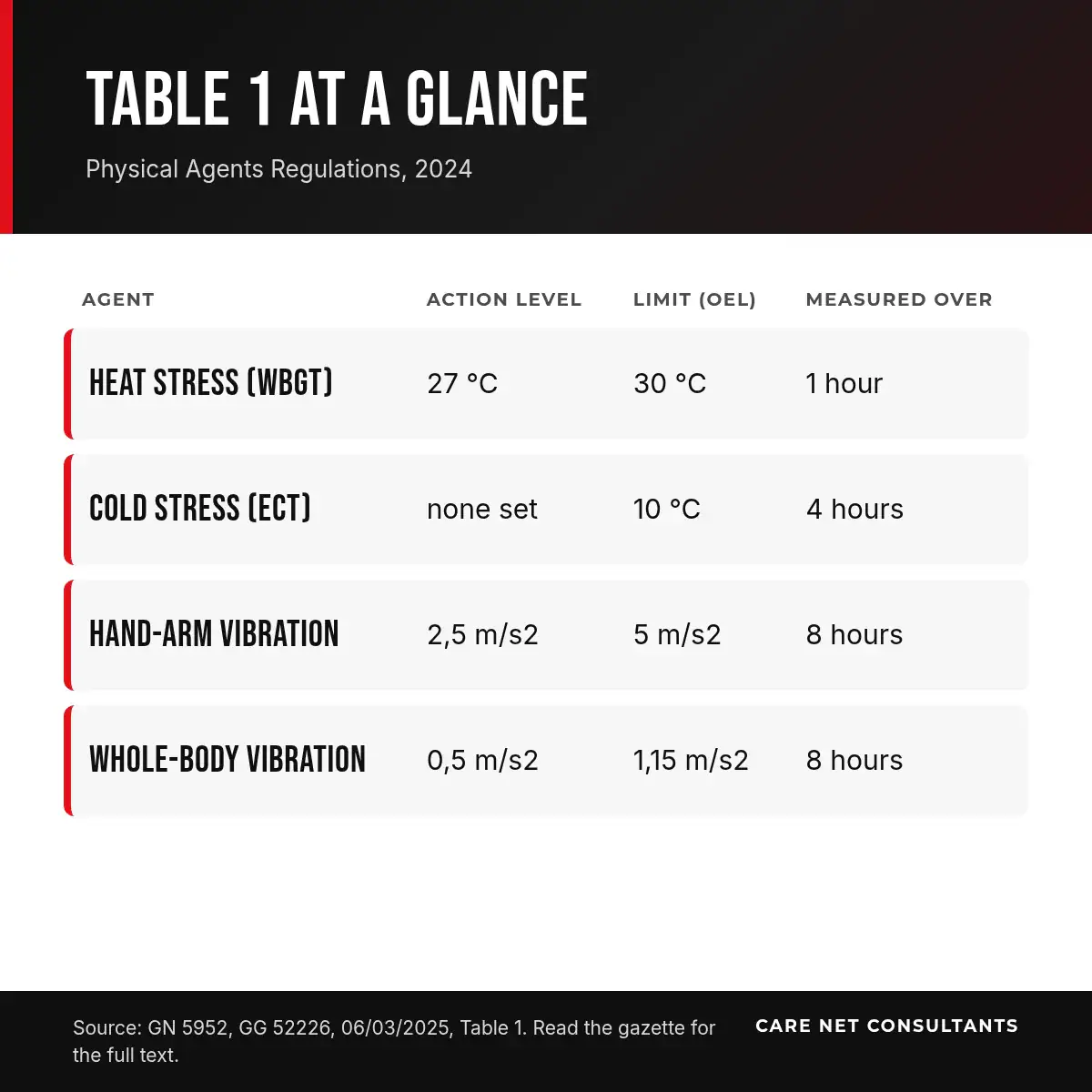
Table 1 of the regulations sets the limits for the agents most farm teams meet. Here they are, copied from the gazette.[1]
| Agent | Action level | Exposure limit (OEL) | Measured over |
|---|---|---|---|
| Heat stress (WBGT index) | 27 °C | 30 °C | 1 hour |
| Cold stress (equivalent chill temperature) | none set | 10 °C | 4 hours |
| Hand-arm vibration | 2,5 m/s2 | 5 m/s2 | 8 hours |
| Whole-body vibration | 0,5 m/s2 | 1,15 m/s2 | 8 hours |
An action level is the point where you must stop and ask why. An occupational exposure limit (OEL) is the line you must not cross without stronger controls. WBGT is the wet-bulb globe temperature index, a heat measure that combines air temperature, humidity, radiant heat and air movement.
Where would a farm meet these? That depends on your operation. Field work in summer is the obvious heat case. Driving tractors and other mobile plant is whole-body vibration. Brush cutters and chainsaws are hand-arm vibration. Cold rooms and packhouses are cold stress. Your own risk assessment decides which apply to you.
What the regulations ask of the employer
The structure is the same for each agent. First, remove the hazard at the source where reasonably practicable. If you cannot, the duties depend on the reading.[1][5]
- At or above the action level (heat and vibration): identify why it was reached and review the controls that stop you reaching the limit.
- At or above the limit: use alternative working methods, review the design and layout of workstations and rest facilities, limit the duration and size of exposure, and review your medical screening and surveillance. For heat, this also includes an acclimatisation programme, prompt first aid and enough drinking water at the place of work.
- Cold stress: limit exposure periods and provide dry, insulated protective clothing.
Underneath sit three duties that apply to every agent:[1]
- A documented risk assessment by a competent person, before exposure where practicable and at least every 24 months (regulation 6).
- Exposure monitoring, where the assessment shows exposure at or above the limits, at a frequency set by the assessment or at least every 24 months (regulation 7). Heat monitoring follows SANS 7243, and whole-body vibration follows SANS 2631.
- Records of training, assessments, monitoring and medical reports, kept for 40 years (regulation 18).
Where the medical comes in
Regulation 8 does not say every worker needs a medical for every agent. It says the risk assessment decides.[1] If it shows a need, the employee must be placed under a documented screening programme, and for a vulnerable employee the employer must get the opinion of an occupational medicine practitioner on whether screening is necessary.
When screening is required, it is carried out by an occupational health practitioner. It includes an initial screening, as far as reasonably practicable before the person starts work, then periodic screening at the interval the occupational medicine practitioner recommends, never more than 24 months. An exit screening follows when employment ends, unless one was done in the previous six months.[1]
Three further points are worth knowing:
- The worker must give written informed consent to screening and surveillance.
- The certificate of fitness may not include confidential medical information.
- A worker may appeal a finding to the Chief Inspector, in writing, within 60 days of receiving the certificate.[1]
Care Net Consultants runs medicals for agriculture and abattoir workers at our clinics and on farms through our mobile units.[6] We will not tell you which workers need screening for heat or vibration. That comes from your risk assessment and an occupational medicine practitioner. We can run the screening they specify.
The cost of waiting
The first cost is human. Heat illness, cold injury and vibration damage are the health effects these limits exist to prevent, and they are cheapest to stop before anyone is hurt.
The legal cost is also written down. Contravening regulations 3 to 18 is an offence, with a fine or imprisonment of up to 12 months, and an extra R200 for each day a continuing offence goes on.[1] An inspector can also direct you to repeat exposure monitoring.[1]
A short list before summer
- Find your last physical agents risk assessment. If it is more than 24 months old, or predates a change in machines or methods, book a competent person.
- Ask what the assessment says about heat, cold and vibration for each job on the farm.
- Check that water, shade, rest breaks and an acclimatisation plan exist for new and returning seasonal workers.
- Ask your occupational medicine practitioner whether any role needs screening, and set the interval.
- Put the 40 year record rule into your filing plan.
None of this requires alarm. It requires a date in the diary.
Questions people ask
What do the Physical Agents Regulations, 2024 cover?
They cover heat stress, cold stress, vibration, illumination, indoor air quality and non-ionising radiation. They were published as GN 5952 in Government Gazette 52226 on 06/03/2025.
What is the heat stress limit in the Physical Agents Regulations, 2024?
Table 1 sets a heat stress action level of 27 degrees Celsius and an exposure limit of 30 degrees Celsius, on the wet-bulb globe temperature index, over 1 hour. Monitoring follows SANS 7243.
How often must the physical agents risk assessment be done?
Before exposure where reasonably practicable, then at intervals not exceeding 24 months, by a competent person. It must be reviewed sooner if work methods, machinery or controls change, after an incident, or if medical surveillance shows an adverse effect.
Do farm workers need a medical under these regulations?
Only where the physical agent risk assessment shows a need, or an occupational medicine practitioner decides screening is necessary for a vulnerable employee. When required, screening is done by an occupational health practitioner with written informed consent.
How long must physical agents records be kept?
For 40 years. Regulation 18 covers training, risk assessments, monitoring, medical screening and surveillance reports, and maintenance of control measures.
Sources
Accessed on 09/10/2026.
- Physical Agents Regulations, 2024 (GN 5952, GG 52226, 06/03/2025), gov.za
- Physical Agents Regulations, 2024, regulation 21 Repeal of regulations (Acts Online)
- GRC Shop: Two OHS Regulations Were Repealed on 06 September 2026
- Physical Agents Regulations, 2024: Amendment (GN 7149, GG 54177, 20/02/2026), gov.za
- Physical Agents Regulations, 2024, regulation 10 Heat stress (Acts Online)
- Care Net Consultants: Agriculture and abattoir medicals
- ENSafrica: Physical Agents Regulations 2024, Noise Exposure Regulations 2024 and General Safety Regulations amendment (11/03/2025)
This article is general information for employers and is not legal or medical advice. Read the regulations for the full requirements and speak to a qualified practitioner about individual health concerns.
← Back to all articles