
Short answer: A missing medical certificate has no price tag in the law. It has three kinds of cost. Construction work by an employee who has no valid certificate means the contractor is not complying with regulation 7(8). There are also penalties under the Occupational Health and Safety Act, and a record you cannot produce when an inspector asks. For construction, regulation 7(8) says a contractor must ensure every employee has a valid certificate of fitness issued in the form of Annexure 3.[1][2] People searching for the cost of non-compliance OHS South Africa often want one number. The law gives a list instead.
A worker arrives at the boom gate at 06:15. The file is on the manager's desk. The certificate tab is empty. Everyone behind him can see it.
Nobody has been hurt, and no inspector is on site. That is exactly why this moment is worth planning for, because it is the cheapest point at which to fix the problem.
We will not put a rand figure on it. No official source gives one, and an invented number would not help you. What the law does give us is a short list of consequences, and you can read each of them for yourself.
Cost one: the contractor's duty
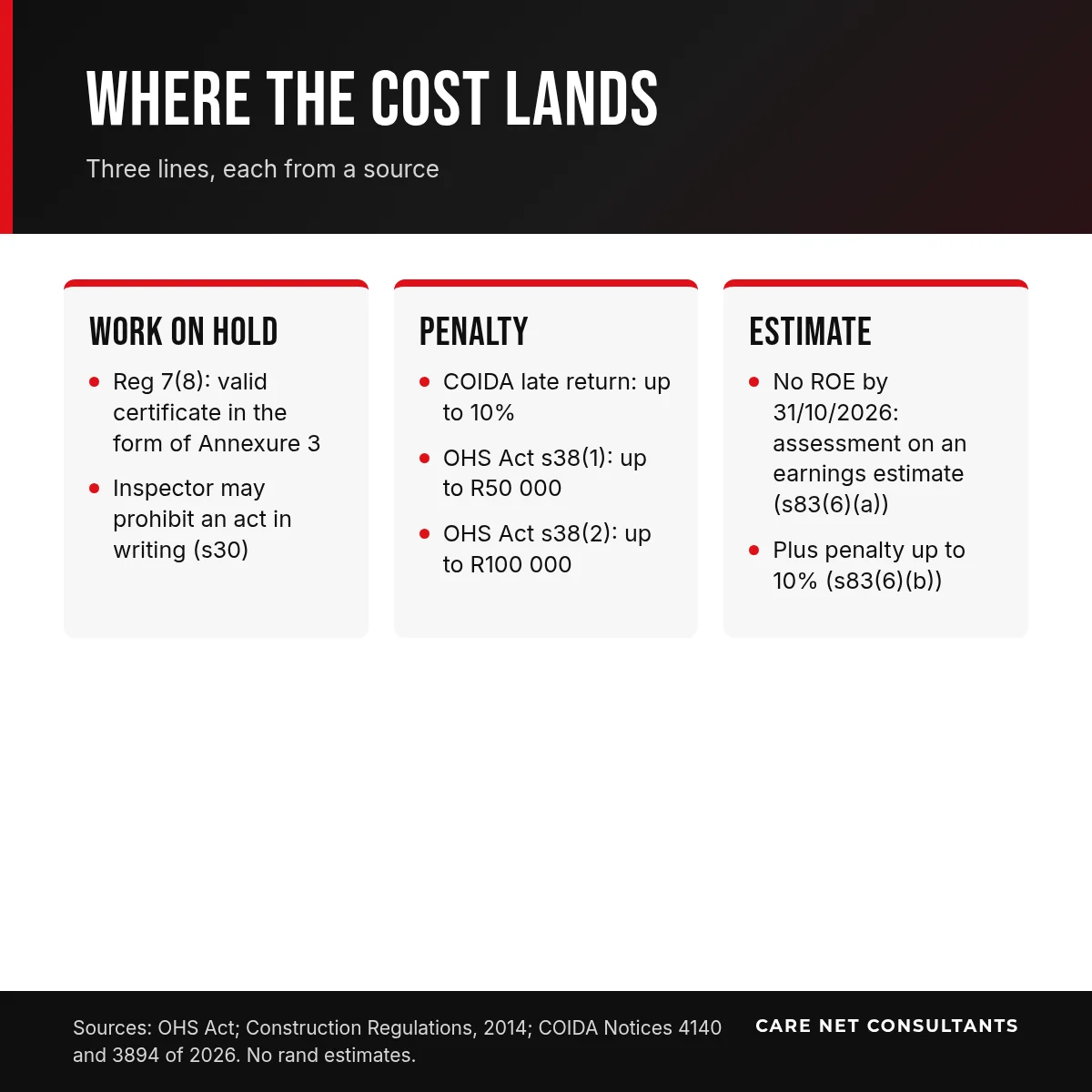
For construction, regulation 7(8) of the Construction Regulations, 2014 is direct. A contractor must ensure that all employees have a valid medical certificate of fitness, specific to the construction work to be performed and issued by an occupational health practitioner in the form of Annexure 3.[2]
If that worker does construction work without a valid certificate, the contractor's duty under regulation 7(8) is not met for that worker. We are not lawyers, and your own advisor should confirm how this applies to your site.
The Act also gives inspectors a power that matters here. Under section 30(1), an inspector who forms the opinion that an act threatens or is likely to threaten the health or safety of any person may prohibit it in writing. To enforce that, the inspector may block, bar, barricade or fence off the part of the workplace concerned (section 30(2)).[1] A missing certificate does not automatically trigger that. A wider pattern of unmanaged risk can.
Cost two: the penalty
The Occupational Health and Safety Act, as published, sets out two tiers:[1]
- Under section 38(1), failing to comply with provisions such as section 8 (the employer's general duties) carries a fine of up to R50 000, imprisonment of up to one year, or both.
- Under section 38(2), where an employer's act or omission causes injury and would have been culpable homicide had the person died, the penalty rises to a fine of up to R100 000, imprisonment of up to two years, or both.
For construction, regulation 33 of the Construction Regulations, 2014 makes a breach of regulation 7 an offence in its own right, with a fine or imprisonment of up to 12 months, and up to R200 or one day's imprisonment for each day a continuing offence goes on (maximum 90 days).[2]
Read those carefully. They do not say a missing certificate leads to a charge. They say that duties exist, that failing them is an offence, and that an injury raises the stakes. The certificate is one piece of evidence that you met your duty.
Cost three: the quiet paper bill
This week's date matters. On 08/09/2026 the Acting Commissioner of the Compensation Fund published Notice 4140 of 2026, a final reminder about outstanding Returns of Earnings (ROEs) for 2025 and earlier years under the Compensation for Occupational Injuries and Diseases Act (COIDA).[3]
If an employer has not submitted before 31/10/2026, the Commissioner may raise an assessment on an earnings estimate basis under section 83(6)(a), and may impose a penalty of 10 per cent of the amount assessed under section 83(6)(b), as amended from 23 January 2026.[7][8] Notice 4140 describes it as up to 10 per cent of the final assessment.[3] 31/10/2026 is a Saturday, so Friday 30/10/2026 is the last working day to plan around.
Notice 3894 of 2026 adds that a 10 per cent penalty applies to late submission after the prescribed deadline, and that interest is charged on accounts after 30 days from the invoice date. The 2025 window ran from 1 April to 30 June 2026.[4] Returns can be submitted online at cfonline.labour.gov.za (ROE Online) or by email to cfcallcentre@labour.gov.za.[3][4]
This has nothing to do with medicals directly. We include it because it shows the pattern. Paper that is not filed on time becomes a cost, and the Commissioner can raise an estimate when you do not supply the real number.
Why the file is the real asset
A medical certificate is both a legal document and a decision record. It shows the employer described the job and its exposures, a practitioner examined the worker against those criteria, and someone signed the outcome. Care Net Consultants' construction medicals include an Annexure 3 and a review by an occupational health nursing practitioner (OHNP).[5]
Outside construction, the same logic applies. Under the Physical Agents Regulations, 2024, the employer must make sure screening is carried out by an occupational health practitioner where the risk assessment calls for it.[6] The file is how you show that you did.
A calm checklist for this week
- Count the workers on site or on the roster, and count the valid certificates. The difference is your gap.
- Check each certificate is specific to the work performed. A certificate for one task does not automatically cover another.
- Put the ROE on someone's diary today if it is outstanding, and check the status on the Compensation Fund's online system.
- Book or quote for the gap. A planned batch is simpler than a worker-by-worker scramble.
- Keep the certificates where an inspector or client can reach them quickly.
What we are not saying
We are not saying a missing certificate will lead to a prohibition notice, a fine or a prosecution. Most gaps are found and fixed long before any of that. We are saying that the cost sits in three places, and each one is cheaper to close before it opens.
Questions people ask
What does a missing medical certificate cost an employer in South Africa?
No official source gives a rand figure. The consequences are in the law: construction work by an employee who has no valid certificate means the contractor is not complying with regulation 7(8), penalties under the OHS Act, and a missing record when an inspector asks.
What are the OHS Act penalties in section 38?
Section 38(1) sets a fine of up to R50 000, imprisonment of up to one year, or both, for failing to comply with provisions such as section 8. Section 38(2) sets up to R100 000, two years, or both, where an employer's act or omission injures someone and would have been culpable homicide had the person died.
Who must ensure construction workers have a medical certificate?
Regulation 7(8) of the Construction Regulations, 2014 says a contractor must ensure that all employees have a valid medical certificate of fitness, specific to the construction work and issued by an occupational health practitioner in the form of Annexure 3.
What is the COIDA Return of Earnings deadline in Notice 4140 of 2026?
Employers with outstanding 2025 and prior year Returns of Earnings must submit before 31/10/2026. After that the Commissioner may raise an estimated assessment and may impose a penalty of 10 per cent of the amount assessed (section 83(6)(b), as amended from 23 January 2026). Notice 4140 describes it as up to 10 per cent.
Sources
Accessed on 09/10/2026.
- Occupational Health and Safety Act 85 of 1993, sections 30 and 38 (gov.za)
- Construction Regulations, 2014 (GN R84, GG 37305, 07/02/2014), regulation 7(8), regulation 33 and Annexure 3 (gov.za)
- Notice 4140 of 2026, final reminder for outstanding Returns of Earnings (GG 55347, 08/09/2026)
- Notice 3894 of 2026, Returns of Earnings (GG 54524, 15/04/2026), Acts Online
- Care Net Consultants: Construction medicals
- Physical Agents Regulations, 2024 (GN 5952, GG 52226), regulation 8
- Compensation for Occupational Injuries and Diseases Amendment Act 10 of 2022, section 51(b) (gov.za)
- Proclamation Notice 306 of 2026 (GG 53990, 23 January 2026), commencement of section 51 (gov.za)
This article is general information for employers and is not legal or medical advice. Read the regulations for the full requirements and speak to a qualified practitioner about individual health concerns.
← Back to all articles