Exit medicals, recorded when the person leaves.
When a worker leaves a noise zone or another declared exposure, the employer still needs a last medical on the file. That medical exit is the closing reading, compared with the baseline, not a farewell form.
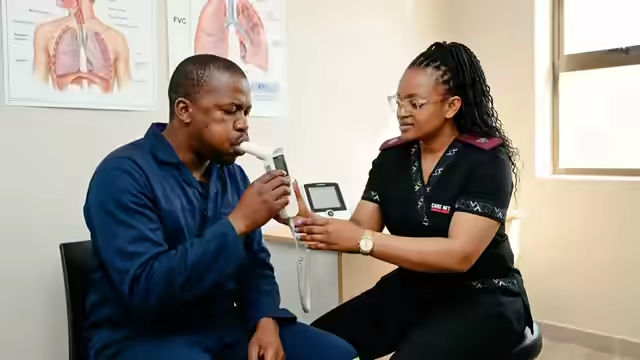

Come to us, or we come to you
Send one worker to a fixed clinic, or book a mobile clinic and run the exit medicals on your site with no travel time lost.
Midrand, Elandsfontein, Brackenfell and Gqeberha
Walk-in and booked medicals at full clinics in Gauteng, the Western Cape and the Eastern Cape.
See our fixed clinics 16 mobile clinics
Medicals on your site
A fully equipped mobile clinic comes to your site or camp. Large teams are tested in a planned window, including Saturdays.
See our mobile clinics
An exit file is the employer's last reading

No last reading, no comparison
If the person leaves a noise zone or a chemical exposure without an exit medical, you have no closing audiogram or spirometry to set against the baseline.

A later claim without a file
A medical exit is how the employer shows what the worker's results were on the last day of exposure. Skipping it leaves a hole in the surveillance record.

Records must outlast the contract
Some medical surveillance records must be kept for decades. Care Net stores the digital file on My Clinic Online for the period the law sets.
Book exit medicals for the crew leaving site
Send the names, the exposures and the last day on the roster. We confirm the panel and the date.

OHS Act and noise rules, on the last day
Exit medicals sit inside medical surveillance. Here is why the employer still books them when a person leaves the exposure, and what goes on the record.
The duty sits with the employer
You must provide a working environment that is safe and without risk to health, so far as is reasonably practicable. Where medical surveillance applies, the programme includes the baseline, the repeats and the medical exit.
Do not treat the last day as optional. Book the exit medical while the person is still on the roster, not after they have gone.
Leave the noise zone with an audiogram
Where workers are in a noise zone, you need a baseline audiogram and later tests that can be compared with it. An exit test closes that file when the person leaves the noise zone.
Put the exit audiogram on the same record as the baseline. Care Net hearing screening follows SANS 10083 so the readings can be compared.
The same panel, last time
The exit medical repeats the tests the surveillance programme already used: questionnaire, physical checks, audiometry where noise applies, spirometry where dust or fumes apply, and any other test the declared exposure requires.
Tell us the job and the exposures. We do not guess a consumer health screen. The panel follows the file you already have.
Kept for the period the law sets
Some records are kept for 5 years. Medical surveillance records for hazardous exposure are kept for 40 years from the date of the last entry, as the Occupational Health and Safety Act and its regulations require.
My Clinic Online holds the digital copy so a lost paper folder is not your only record when an inspector or a later claim arrives.
Who we see for a medical exit
Workers leaving a noise zone, a chemical exposure, a dust or fume role, construction or mining surveillance, or any other job your programme already watches. This page is for employers closing an occupational file, not for a private discharge summary.
If the person is new, start with a pre-employment medical. If they still work in the exposure, keep them on medical surveillance. If hearing is the issue, use audiometry.